

APIs are now at the center of most modern applications, which makes securing them a lot more critical and a lot more complex. Choosing from the best API security tools directly impacts how much visibility your team has, how quickly you can respond to threats, and how well security fits into your development workflow.
For security leaders, platform teams, and engineering managers, this isn’t just a tooling decision anymore. API attacks have become one of the most common application threat vectors, especially in production environments where APIs are constantly evolving.
From what I’ve seen across G2 reviews and real-world usage, the challenge isn’t just finding a tool with strong features. It’s finding one that works the way your team does. Some tools are better at discovering unknown APIs, others fit more naturally into CI/CD pipelines, and some handle production traffic and scale more effectively.
To help you evaluate your options, I analyzed patterns across G2 reviews and hands-on feedback from teams using these tools in live environments. This guide focuses on what matters most: which tools solve specific API security challenges and how to choose the right fit for your stack.
The API security tools you choose today determine how much visibility, control, and response speed your team has when it matters most.
*These API security tools are top-rated in their category based on G2’s Winter Grid Report. I’ve included their strengths and pricing details to help you choose the right solution for your team's workflows.
At a basic level, API security tools help teams get a clear view of what’s actually happening across their API landscape. Instead of dealing with undocumented endpoints or unclear exposure, you get visibility into what exists, how it’s being used, and where risks might be building.
From what I’ve seen in G2 reviews, the difference between average and strong tools comes down to context. It’s not just about flagging vulnerabilities. The better platforms show how APIs change over time, who or what is calling them, and which issues actually matter in production.
Another thing that stands out is how widely these tools are used. G2 data shows adoption across small teams, mid-market companies, and enterprises, which reflects how central APIs have become to modern applications. Teams tend to value tools that are quick to deploy, integrate with CI/CD pipelines and gateways, and start delivering insights without long setup cycles.
The goal is straightforward: understand what APIs you have, see how they’re being used, and catch real risks before they turn into incidents. When a tool does that well, it supports development instead of slowing it down.
I used G2’s Grid Reports to shortlist leading API security tools based on verified user satisfaction scores and market presence across small teams, mid-market organizations, and enterprises operating API-driven products.
From there, I analyzed hundreds of verified G2 reviews using AI to extract recurring feedback patterns tied to real-world API security workflows. This helped separate platforms that genuinely reduce exposure from those that add monitoring noise or slow release velocity as API surfaces grow.
Because I haven’t personally deployed every platform listed, I validated these patterns through ongoing conversations with security, platform, and engineering teams actively using API security tools in production environments.
The screenshots, visuals, and product references included here are sourced from G2 vendor listings and publicly available product documentation, ensuring consistency with how these tools are positioned and experienced in the field.
After combing through G2 Data, category requirements, and hundreds of verified user reviews, I kept seeing some very common priorities surface across roles such as HR leaders, people ops managers, and workforce planning teams.
Below are the criteria that consistently matter:
Choosing among API security tools always involves trade-offs. Some teams prioritize deep runtime protection, others focus on early lifecycle testing, and some need strong governance across sprawling environments. There is no universally best option. The right choice depends on where API risk first appears in your organization and how closely security must align with delivery speed.
To be evaluated under API security tools, platforms must meet the following baseline criteria:
This data was pulled from G2 in 2026. Some reviews may have been edited for clarity.
Postman is widely used to design, test, verify, and validate APIs before they reach production. Teams rely on a single workspace to manage requests, authentication, and response validation without switching tools.
On G2, features like API testing are rated at 96% and API verification at 94%, indicating strong alignment with real testing workflows. Collections, environments, and scripting support repeatable validation across endpoints. Teams describe fewer missed checks as APIs evolve. These capabilities help maintain consistency as APIs move toward production. The emphasis stays on practical, developer-driven testing.
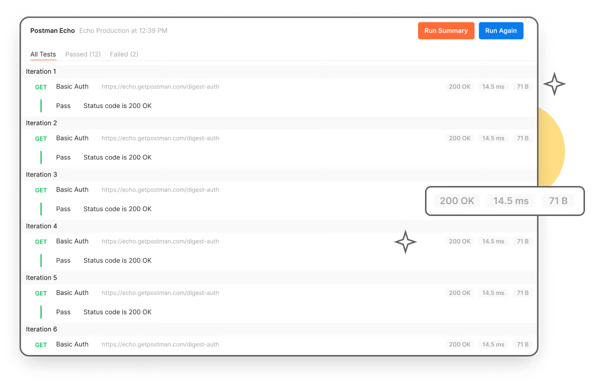 Shared collections and reusable environments allow teams to standardize tests across developers. Workspace permissions support review and change control without slowing iteration. This consistency matters when multiple contributors touch the same APIs. It reduces the risk of environmental drift or untested changes. For growing teams, shared standards become easier to maintain.
User analytics features score above category average on G2, reflecting how teams track request execution and coverage trends. G2 reviews point to better awareness of how APIs are exercised over time. This visibility helps teams spot gaps earlier rather than relying on manual review. As API surface area grows, this becomes more important. It supports informed decisions without adding extra tooling.
G2 feedback shows that teams can send requests and validate responses quickly without heavy setup. Saved collections and environments reduce repetitive work over time. Tests become easier to reuse rather than being recreated for each release. This compounds productivity as projects grow. It also lowers the barrier for new team members joining ongoing work. G2 rates ease of setup at 95%, the strongest in the category, reflecting how quickly teams move from installation to active testing.
G2 reviewers describe Postman's CI/CD and Git integrations as a consistent workflow accelerator. Teams use Newman for pipeline runs without switching tools. The ability to import and export collections also reduces onboarding friction when new developers join a project.
Postman's AI features, particularly Postbot, surface repeatedly in recent G2 reviews. G2 reviewers describe it as helping write test scripts, set environment variables, and guide newer users through API setup. This reduces the entry barrier for developers who are not security specialists.
Large collections and heavily scripted test suites can introduce performance variability, with some G2 reviewers noting slower load times on lower-spec systems. This is more noticeable for teams running extensive automation workflows as projects scale, while standard collections and environment setups align well with everyday testing needs.
Some advanced collaboration and automation features are available in paid plans, which G2 reviewers on free or lower tiers highlight as a consideration for smaller teams. This is most relevant for budget-conscious teams evaluating full automation workflows, while the free tier aligns well with core API testing and verification use cases.
Overall, it fits teams that want reliable API testing and verification embedded directly into development workflows. It works best where collaboration, usability, and consistency matter more than specialized runtime threat defense.
“We use Postman for building and testing applications, and it works so well. It comes equipped with AI features for easy building of apps, and this automation saves time. It comes with great security features that guarantee security and easy access. Being an API platform, it is well equipped, and the building automation features make it irresistible.”
- Postman review, Daniel G.
“While basic implementation is easy, advanced features such as scripting, automation, and monitoring require more time to learn and configure. The tool can feel bloated for simple use cases, and performance may degrade with large collections. Some essential collaboration and automation features are only available on paid plans, which limits ease of implementation for teams on a budget. Customer support can also be limited unless you are on higher-tier plans.”
- Postman review, Dhruv K.
Cloudflare Application Security and Performance acts as a perimeter security layer for APIs and web applications. Teams use it to protect production traffic while improving delivery speed through its global edge network.
G2 Data shows anomaly detection, API testing, and compliance monitoring, each rated at 100% satisfaction. These controls apply consistently without frequent rule tuning. Teams describe policies continuing to perform reliably once enabled. This approach suits environments where manual adjustments are costly, keeping protection active as APIs scale without interrupting delivery workflows.
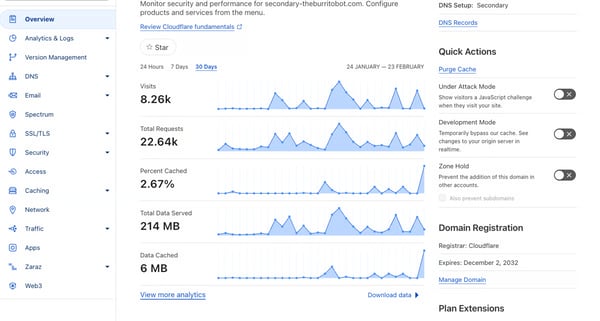
G2 reviews reference analytics that surface request behavior, attack attempts, and abnormal patterns at the edge. This helps teams understand how APIs are used in production. Security events can be reviewed without adding separate monitoring tools. Visibility supports quicker investigation when issues arise. Teams gain context alongside protection. This reduces blind spots in live traffic.
Teams report enabling WAF rules, rate limiting, bot management, and DDoS mitigation quickly. Setup does not require long configuration cycles. Coverage can be applied early in an API’s lifecycle. This is useful in fast-moving or resource-constrained environments. Protection becomes available before traffic grows. It supports early-stage production readiness.
The CDN and caching layer reduce latency while security filters unwanted traffic. Users associate this with faster response times and fewer disruptions. Reduced load also lowers infrastructure strain. Over time, this combination supports cost control.
This combination of performance and protection appeals especially to smaller teams, reflected in adoption, where 62% of users come from small businesses prioritizing coverage without managing separate systems.
G2 reviewers consistently highlight WAF rules, bot management, and DDoS mitigation working together without requiring separate tools or configurations. Teams describe blocking credential stuffing, scraping, and API abuse through a single policy layer. This consolidation reduces operational overhead for teams that would otherwise manage multiple security vendors.
Recent G2 reviews point to Cloudflare's DNS management, SSL, and email routing as additional utilities that teams use daily alongside security features. G2 reviewers describe the platform as an all-in-one infrastructure layer rather than a point security tool. For smaller teams, especially, this breadth reduces the need to manage separate vendors for core web operations.
Advanced edge rules, custom workers, and non-default configurations reflect a more technical, configuration-driven approach. G2 reviewers note that this aligns well with teams experienced in API security and infrastructure-level customization, while those working primarily with default setups may find the model more specialized. The depth of control aligns well with complex environments requiring tailored API security behavior.
Pricing scales with traffic volumes and feature tiers, which becomes more noticeable as usage expands beyond initial requirements. Teams on free or lower plans may encounter feature boundaries as needs grow, while organizations operating at a larger scale align well with the platform’s usage-based model and feature depth.
Overall, it fits teams that want always-on API protection and performance optimization at the edge. It works best where live traffic quality and uptime take priority over pre-release testing depth.
”I like most in the Cloudflare application is Bot management, rate limiting, and custom policies, as per the requirement, we can adjust the request in a certain time frame. This is one of the most thrilling features, and many more that help us to keep a safe application with Cloudflare.”
- Cloudflare ASP review, Balaji U.
“Some advanced configuration options (especially for workers and edge rules) can be confusing at first, and documentation sometimes assumes you’re already technical. Pricing for higher-tier security and traffic limits can escalate quickly if your usage grows suddenly. Apart from that, the platform has been stable overall.”
- Cloudflare ASP review, Ajay V.
apisec.ai is used by teams that want security testing embedded earlier in the API development lifecycle. It is applied to continuous vulnerability discovery across REST, GraphQL, and gRPC APIs. Teams rely on it to replace manual penetration testing with repeatable, automated scans.
Browser-based setup, Swagger and Postman imports, and CI/CD integrations allow scans to run directly inside pipelines. This removes the need for separate security tooling or handoffs. Developers receive findings in the same context as their builds. Security validation becomes part of the normal delivery flow. This supports DevSecOps execution. Testing remains consistent across environments. G2 rates ease of setup at 90% and ease of use at 92%, consistent with reviewers describing minimal friction once scans are configured.
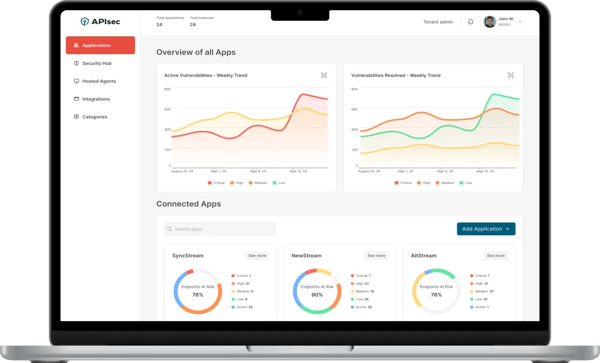
G2 reviewers describe the dashboard as one of apisec.ai's most practical elements for day-to-day use. Vulnerability trend graphs and endpoint risk charts give security and developer teams a fast read on where exposure is concentrated. G2 reviewers note that findings are presented in a way that non-security specialists can act on without needing to interpret raw scanner output. CVSS-based risk scoring helps teams prioritize what to address first rather than working through an undifferentiated list of findings.
Features like API Testing are rated at 91%, with API verification and reporting close behind at 90%. Teams use these features to identify OWASP Top 10 issues across endpoints. Findings are presented in a way that developers can act on quickly. Automated scans replace ad-hoc manual checks. Coverage scales across multiple APIs. Reliability remains steady across projects.
Scan scheduling and automatic endpoint discovery surface repeatedly in reviews. Teams avoid maintaining test logic manually. New endpoints are tested as they appear. This reduces gaps caused by rapid API changes. Over time, security effort shift from execution to remediation. Releases move faster with fewer escalations.
G2 reviewers describe Postman and Swagger import options as significantly reducing setup time. Browser-based access means no installation overhead. Teams report being able to run their first scan within minutes of onboarding, which shortens time-to-value in active development cycles.
Recent reviews highlight apisec.ai's multi-host management and support for REST, GraphQL, and gRPC APIs as a practical advantage for teams managing varied API estates. Endpoint discovery runs automatically as new routes appear. This reduces the manual effort of keeping test coverage aligned with a fast-changing API surface.
G2 Data shows 64% small business usage, 23% mid-market, and 13% enterprise. This profile reflects strong adoption among developer-led teams where security testing needs to fit naturally inside the delivery cycle without specialist overhead.
Reporting flexibility is an area where G2 reviewers identify limitations. Scheduled scan reports are not automatically delivered to subscribed email addresses, and findings lack endpoint-level segregation, which is more noticeable in teams managing detailed vulnerability workflows. This is more noticeable in environments requiring granular traceability, while automated coverage and CI/CD integration align well with standard DevSecOps use cases.
Test customization depth is most relevant for teams with highly specific business logic requirements or complex, multi-step API flows. G2 reviewers note that advanced scenario configuration reflects a more defined model beyond default capabilities, which is more noticeable in highly customized workflows. Teams working with standard REST or GraphQL APIs align well with the platform’s automated coverage approach.
apisec.ai holds its strongest fit with teams that want automated API security testing running continuously alongside development. Overall, it supports organizations prioritizing early detection and broad coverage without slowing delivery velocity.
”apisec.ai makes API security testing incredibly simple and automated. The platform continuously scans APIs, detects vulnerabilities in real time, and provides actionable remediation steps. I really like how easy it is to set up, and the integration options with CI/CD pipelines are seamless. Their dashboards are intuitive, and the detailed reports save a lot of manual effort for security teams.”
- apisec.ai review, Prathmesh K.
“There are some areas for improvement. While scheduled scans execute as expected, the reports are not automatically sent to subscribed email addresses, which affects workflow efficiency. Additionally, the tool lacks endpoint-wise segregation of vulnerabilities, making it harder to trace issues back to specific components. The report also falls short in providing detailed descriptions of the discovered vulnerabilities. Including proof-of-concept (PoC) examples and remediation guidance would greatly enhance the usability and clarity of the reports.”
- apisec.ai review, Saurabh K.
Rakuten SixthSense Observability is used to monitor APIs and applications in live, production-heavy environments. Teams deploy it to gain centralized visibility across APIs, services, logs, metrics, and traces.
G2 reviews describe APIs, applications, and infrastructure signals accessible through a single interface. Metrics, logs, and traces are correlated without switching tools. This reduces investigative handoffs during incidents. Teams spend less time stitching data together. Troubleshooting becomes more direct. Operational context remains intact throughout analysis.
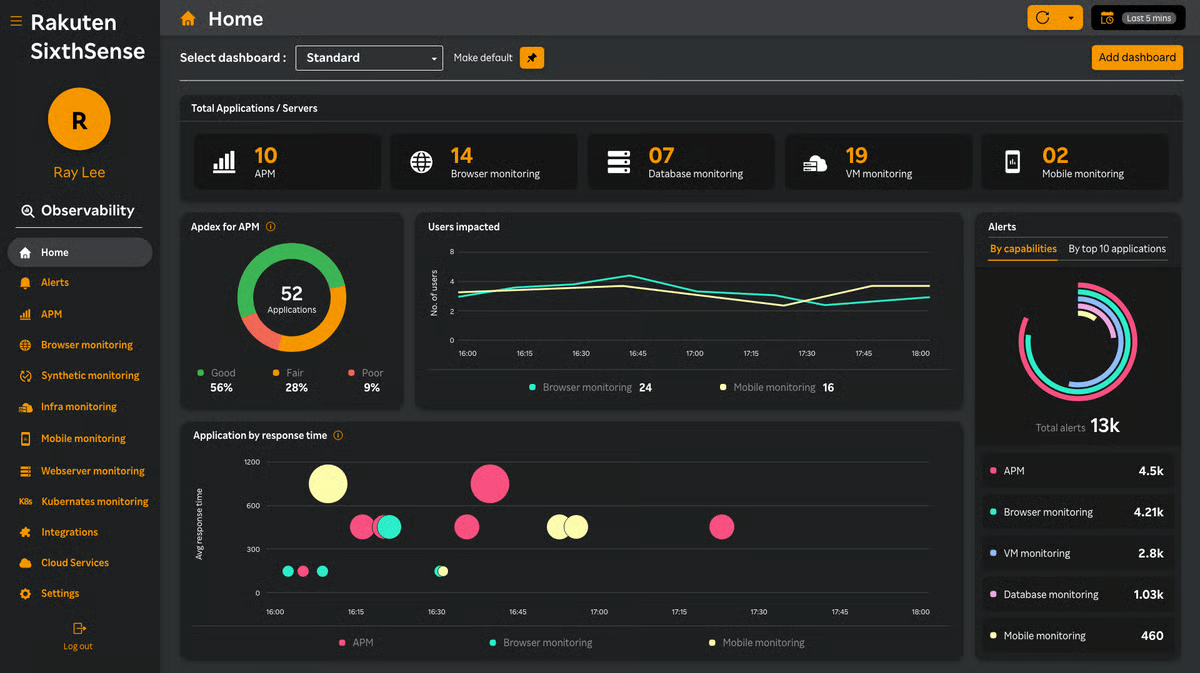
G2 Data reports API Verification, API Monitoring, and API Discovery, each scoring 100%. Teams maintain continuous awareness of exposed endpoints and traffic behavior. Changes in usage patterns surface quickly. This supports proactive detection of issues before escalation. Monitoring remains active without manual intervention. Coverage stays consistent as APIs evolve.
Users describe linking slow endpoints directly to downstream service calls. Alerting and real-time dashboards help teams respond as issues emerge. Investigations move from symptoms to causes more quickly. This shortens incident response cycles. The mean time to detect and resolve issues improves. Reliability metrics benefit over time.
G2 reviews reference reduced MTTD and MTTR after moving observability workflows into SixthSense. Fewer handoffs are needed between teams. Incident ownership becomes clearer. Engineering effort shifts away from coordination toward resolution. Productivity improves across operations. These compounds as environments grow.
G2 reviewers describe Rakuten SixthSense's integration capabilities as broad and straightforward to activate. Teams connect it to existing alerting systems, cloud services, and infrastructure stacks without significant reconfiguration. This wide integration surface means the platform fits into existing workflows rather than requiring teams to rebuild observability processes around it. G2 rates ease of setup at 93% for Rakuten SixthSense, reflecting the integration experience reviewers describe as straightforward despite the platform's broad connectivity.
Initial setup in environments with many services, diverse tech stacks, or legacy components reflects a configuration-heavy model, with data sources and dashboards requiring alignment across systems. This is more noticeable for enterprise teams onboarding at scale, while organizations operating within standardized environments align well with the platform’s unified visibility across complex systems.
Reporting depth and dashboard customization become more central as teams manage larger API estates. G2 reviewers note that this is more noticeable in highly distributed environments, where internal standards and familiarity influence how teams structure reporting workflows. Teams operating at scale align well with the platform’s comprehensive feature set across API verification, monitoring, and discovery.
Overall, Rakuten SixthSense Observability fits enterprise teams that prioritize real-time API monitoring and discovery within a unified observability platform, where runtime insight drives reliability and incident response.
”Rakuten SixthSense provides real-time insights into the performance and behavior of configured alerts, allowing organizations to monitor, analyze, and troubleshoot issues efficiently. It offers comprehensive visibility into various aspects of applications, infrastructure, and services. It's easy and quick to integrate the Rakuten SixthSense alerts into the project. By integrating Rakuten SixthSense, it provides advanced monitoring, logging, and tracing capabilities, and offers unparalleled insights into the inner workings of complex environments.”
- Rakuten SixthSense Observability review, Naidu M.
“Need to cover CDN performance monitoring as a part of the product.”
- Rakuten SixthSense Observability review, Amit J.
Orca Security is used to evaluate API exposure within the broader context of cloud infrastructure risk. Teams deploy it as part of CNAPP or CSPM programs to understand how APIs connect to identities, configurations, and exposed services.
G2 Data shows cloud registry scoring 95% and cloud gap analytics at 92%, both above category averages. These features map API dependencies across cloud services. Misconfigurations that elevate exposure are surfaced quickly. Identity context is included in the analysis. SSO at 94% supports centralized access control. This strengthens alignment in governed environments.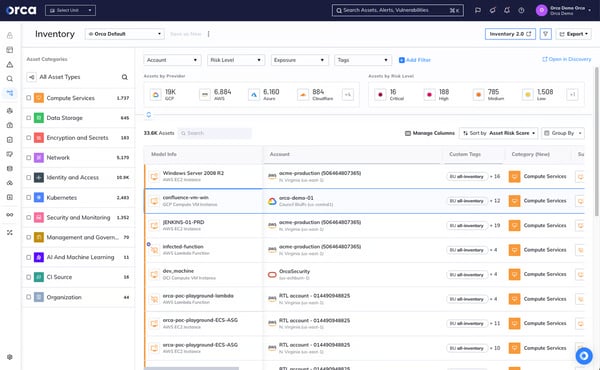
G2 reviews often highlight how teams are able to identify excessive permissions, vulnerable assets, and API-related misconfigurations more quickly. AI-assisted search helps reduce the need to manually correlate data across multiple tools, while centralized dashboards bring findings into a single, unified view. This makes remediation more focused, with less time spent gathering context and more effort directed toward fixing issues.
Agentless deployment also makes it easier to roll out across accounts, while centralized posture analysis supports scaling across environments. As a result, teams can maintain more consistent coverage, even across multiple cloud providers.
RBAC controls, reporting exports (87%), and API-based data access support oversight needs. These capabilities matter as security programs mature. Access and reporting align with internal policies. This supports audit and compliance workflows.
Risk prioritization improves over time when teams describe a clearer focus on high-impact issues connected to APIs. Attack path analysis reduces noise. Exposure is ranked by context rather than volume. This helps prevent alert fatigue. Security efforts become more targeted. Outcomes improve as environments grow.
G2 reviewers describe Orca's SSO integration and RBAC controls as practical for security teams operating in governed enterprise environments. Centralized access management reduces the overhead of maintaining separate controls across cloud accounts. G2 rates SSO at 94% for Orca, reflecting how access control integrates cleanly into enterprise governance frameworks. These capabilities matter most as security programs move toward formal audit and compliance workflows.
Dashboard flexibility and reporting customization are most relevant in very large environments where internal security models diverge from default views. G2 reviewers in complex, multi-account deployments note that this is more noticeable in highly customized setups, while the platform’s agentless deployment aligns well with low operational overhead across standard environments.
The platform’s primary strength is cloud-wide posture and risk context rather than dedicated API-layer testing. API testing (79%) and bot detection (66%) feature scores sit below Orca’s other capability areas, reflecting that focus. For organizations evaluating API risk within a broader CNAPP or CSPM program, Orca’s contextual attack path analysis and cloud registry coverage align well with these use cases.
Orca Security fits mid-market and enterprise teams that want API risk evaluated within a full cloud security context. Overall, it supports organizations prioritizing posture-driven visibility and remediation across complex cloud environments, with Cloud Gap Analytics remaining central to risk prioritization.
”The interface is very intuitive, and there was no learning curve at all. Being able to create reports on pretty much any dashboard has been very helpful. Vulnerabilities and misconfigurations identified by Orca provide our development team with more than enough information for remediation without any additional research. Overall, this is a very well-thought-out platform.”
- Orca Security review, Jay B.
”The only missing offering is a cached dashboard to be used on team area kiosk dashboards within the team areas and displaying only that business unit's information.”
- Orca Security review, Jackson B.
Check Point CloudGuard WAF is deployed as a managed runtime protection layer for cloud-hosted applications and APIs. Teams use it to inspect live traffic and block Layer 7 attacks as they occur. The platform operates continuously in production environments.
G2 reviews reference AI-driven detection, virtual patching, and automatic policy updates. These capabilities allow defenses to adapt without constant manual tuning. Teams rely on this to maintain coverage as threats evolve. Rule maintenance effort is reduced. Security teams focus on oversight rather than daily adjustments. G2 rates security and policy enforcement at 92%, consistent with reviewers describing defenses that adapt without constant manual attention.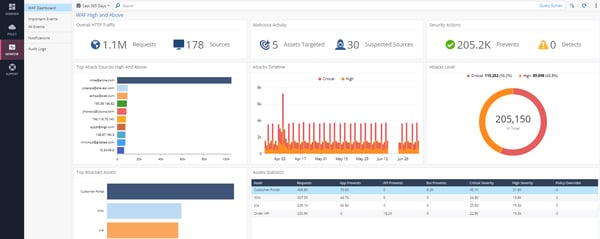
G2 reviews reference AI-driven detection, virtual patching, and automatic policy updates. These capabilities allow defenses to adapt without constant manual tuning. Teams rely on this to maintain coverage as threats evolve. Rule maintenance effort is reduced. Security teams focus on oversight rather than daily adjustments. This supports stable runtime defense.
Virtual patching plays a practical role in risk management, where teams use it to mitigate OWASP Top 10 threats and zero-day exploits when code fixes are delayed. This helps prevent exposure during long development cycles. Protection can be applied immediately. APIs remain available while remediation is planned. This reduces pressure on engineering teams. Security posture remains intact.
G2 Data shows 75% adoption concentrated among mid-market teams, alongside 15% enterprise and 10% small business. This profile fits teams that have outgrown native cloud WAFs. The platform scales without requiring custom stacks. Coverage remains consistent as environments grow.
Features like API verification scores 94%, while API monitoring and reporting each score 93%. These features support visibility and enforcement once APIs are exposed to live traffic. Teams rely on consistent inspection rather than pre-deployment testing. Monitoring remains active under load. Reporting supports operational review.
Operational efficiency improves once protections are in place. Teams describe fewer false positives and quicker response to active threats. Automated updates reduce response time. Incident handling becomes more predictable. Manual intervention is required less often. Security workflows stabilize over time. G2 rates ease of setup at 90% and ease of use at 91%, consistent with reviewers describing smooth initial deployment even in cloud-native environments. This supports sustained production defense.
Policy configuration and dashboard navigation reflect a more structured model in tailored or non-standard environments. G2 reviewers new to the Check Point ecosystem note that this is more noticeable when customizing rules beyond default setups, while teams operating within standard configurations align well with the platform’s consistency and detection approach.
Advanced capabilities and higher-tier features are tied to pricing tiers, which become more noticeable for teams scaling coverage or implementing complex rule customization. G2 reviewers highlight this when comparing the platform with simpler WAF alternatives, while organizations adopting the full feature set align well with its depth of protection and low false-positive profile.
Check Point CloudGuard WAF fits mid-market teams seeking automated, production-grade API protection, where runtime inspection and abuse prevention matter more than pre-release testing depth.
”I appreciate the proactive and AI-driven threat prevention offered by Check Point CloudGuard WAF. It effectively detects and blocks threats like SQL injections, remote code execution, and automated bots without the need for traditional signature updates. This advanced AI-driven security extends protection against a wide range of threats, including zero-day exploits and API attacks, all with minimal effort. I find the product’s capability to ensure comprehensive threat coverage with reduced manual intervention to be highly valuable. Additionally, the initial setup process is very easy, which facilitates a smooth adoption and fast deployment.”
- Check Point CloudGuard WAF review, Oscarina S.
”While the core WAF functionality is excellent, the reporting and dashboard visualization could be improved for enterprise-level visibility. It sometimes requires extra effort to correlate specific security events across a large fleet of applications outside of the primary console. Furthermore, the initial licensing model required a bit more negotiation to align perfectly with our specific scale-out architecture. However, the strong Customer Support helped us resolve these initial issues quickly.”
- Check Point CloudGuard WAF review, Alejandro M.
|
Software |
G2 rating |
Free plan |
Ideal for |
|
4.6 / 5 |
Yes |
Agile teams managing complex API development, testing, and collaboration workflows |
|
|
4.5 / 5 |
Yes (limited) |
Teams needing always-on API protection, DDoS mitigation, and performance optimization at the edge |
|
|
4.7 / 5 |
NA |
DevSecOps teams seeking fully automated, CI/CD-driven API security testing |
|
|
4.6 / 5 |
No |
Enterprise teams prioritizing real-time API monitoring and observability across complex systems |
|
|
4.6 / 5 |
No |
Mid-market and enterprise teams evaluating API risk in a full cloud and identity context |
|
|
4.4 / 5 |
No |
Mid-market organizations needing automated runtime API and web app protection |
*These API security tools products are top-rated in their category, based on G2’s Winter Grid® Report.
Got more questions? G2 has the answers!
Postman and apisec.ai are the strongest fits for DevSecOps teams. Both integrate directly into CI/CD pipelines, allowing teams to validate and test APIs during development rather than after deployment. apisec.ai automates continuous scanning while Postman supports collection-based test automation through Newman.
Check Point CloudGuard WAF uses AI-driven detection and automatic policy updates to block zero-day exploits, API attacks, and bot traffic without relying on manual rule tuning. Cloudflare Application Security and Performance applies machine learning at the edge to detect anomalies and block credential stuffing, scraping, and DDoS attacks in real time. Both platforms adapt to evolving threats without requiring constant manual intervention.
Cloudflare Application Security and Performance provides always-on protection with live anomaly detection at the edge, blocking threats before they reach production APIs. Rakuten SixthSense Observability delivers real-time visibility into API behavior, performance signals, and security events across production environments. Both platforms surface issues as they occur rather than in post-event reports.
Rakuten SixthSense Observability and Orca Security are commonly adopted by teams managing large, distributed API environments. Rakuten SixthSense consolidates metrics, logs, and traces across complex infrastructures, while Orca maps API exposure across multi-cloud estates with agentless deployment. Cloudflare also scales well for high-traffic environments through its global edge network.
Public-facing APIs benefit most from runtime protection tools like Cloudflare Application Security and Performance and Check Point CloudGuard WAF, which filter malicious traffic and enforce policies in production. Private and internal APIs are often protected earlier in the lifecycle using Postman and apisec.ai, which focus on testing, verification, and discovery before exposure. The right approach depends on where in the API lifecycle your primary risk sits.
Orca Security and Check Point CloudGuard WAF are frequently used in regulated environments, providing audit-ready reporting, structured risk prioritization, and traceable controls across cloud and API layers. apisec.ai supports compliance through continuous OWASP API Top 10 coverage and CI/CD-integrated testing that produces documented findings at each release. The strongest compliance programs typically combine pre-release testing with runtime enforcement.
Large organizations typically layer multiple tools based on where risk shows up first. Orca Security and Rakuten SixthSense Observability are often chosen for cloud-wide and runtime visibility, while Cloudflare Application Security and Performance and Check Point CloudGuard WAF handle production protection. Developer and security teams may still rely on Postman or apisec.ai earlier in the lifecycle.
Postman and apisec.ai help identify authentication and access control flaws during development, including broken object-level authorization and misconfigured token handling. Cloudflare Application Security and Performance and Check Point CloudGuard WAF enforce authentication policies in production to prevent unauthorized access and abuse at the edge. Catching these issues early with testing tools reduces the remediation burden once APIs are live.
apisec.ai detects exposure and logic flaws early in the development cycle, helping teams remediate before APIs reach production. Cloudflare Application Security and Performance and Check Point CloudGuard WAF monitor live traffic to stop scraping, credential abuse, and data exfiltration attempts in real time. Combining pre-release testing with runtime protection gives the most complete coverage.
apisec.ai is purpose-built for API vulnerability scanning, covering OWASP API Top 10 issues, logic flaws, and undocumented endpoints with automated, continuous scans. Postman supports structured endpoint validation and scripted testing as part of development workflows. For teams that also need runtime visibility alongside scanning, Orca Security surfaces API-layer risk within broader cloud posture analysis.
If there’s one thing that stands out when evaluating API security tools, it’s that this category has moved beyond point-in-time vulnerability scanning. These tools now shape how teams understand and manage their API surface on a daily basis.
In practice, the difference comes down to how well a tool fits into your workflow. The strongest platforms don’t just surface issues; they plug into CI/CD pipelines, gateways, and runtime environments so teams can catch risks early and act on them without slowing releases.
What I’ve seen across G2 reviews is that there’s no single “best” tool for everyone. Some teams need deeper visibility and discovery, while others prioritize runtime protection or abuse prevention at scale. The right choice depends on where your biggest gaps are today and how your API footprint is evolving.
That’s why it’s worth looking beyond feature lists. Focus on how a tool will actually change your day-to-day—how quickly it surfaces meaningful issues, how easily teams can act on them, and whether it keeps up as your APIs grow.
Want stronger control over your API surface? Explore leading API management tools on G2 to help teams govern API lifecycles, manage traffic, and bring structure to how APIs are exposed and secured.

Choosing the best firewall software isn't just about finding the most recognized name in the...
 by Soundarya Jayaraman
I've reviewed enough G2 data on cloud infrastructure to know that the best cloud data security...
 by Disha C

TL;DR Virtru Secure Share is the best cloud file security software as per G2’s latest Summer...
 by Barkha Bali