


An Android developer can determine whether your mobile product ships on time or stalls mid-build. Delays in feature releases, unstable builds, and inefficient iterations are all too common when development partners can't keep pace with evolving requirements.
With Android powering more than 70% of global mobile devices, teams need tools that deliver reliability and scalability, not slowdowns. Based on extensive analysis of user reviews and workflow insights, I’ve identified the best Android developers in the market today.
Reliable partners excel at maintaining stable release pipelines, ensuring clear communication during development cycles, and adapting quickly as product needs change. Weak tools lead to missed deadlines, shifting scopes, and ultimately, stalled roadmaps.
In this guide, I’ll highlight the tools most suited for different team needs. The top 5 Android developers include Digital Aptech, Tapptitude, Chetu, Wolfpack Digital, and Teravision Technologies.
* These Android developers are widely recognized in the category based on G2's Winter 2026 Grid® Report. I’ve highlighted where each provider commonly fits best so teams can align project needs with the right development partner.
Android development services help organizations turn product ideas, feature requirements, and mobile strategies into fully functional Android applications that users rely on every day. The right Android development partner does more than write code. They help teams design scalable architecture, deliver stable releases, and maintain performance as the app grows and user expectations rise.
What I kept finding across G2 reviews is that the gap between a good development partner and a difficult one rarely comes down to technical skill. It comes down to how they communicate when something changes mid-build, which is where most Android projects either hold together or start to drift.
Strong Android development partners give teams what every mobile product initiative needs: reliable execution, scalable architecture, and the confidence that the mobile experience can grow alongside the business.
I used G2's Winter 2026 Grid® Report to shortlist Android developers based on real client satisfaction scores and market presence across small businesses, mid-market companies, and enterprise organizations.
I then used AI to analyze hundreds of verified G2 reviews and identify recurring feedback patterns around what matters most in real Android development engagements. This included delivery reliability, communication throughout development cycles, ability to adapt to changing product requirements, technical expertise in Android architecture, and the overall quality of collaboration between development teams and internal product stakeholders.
I validated these findings against broader review insights from product teams, engineering leaders, and organizations that have partnered with these companies for Android development. The visuals and company references included in this article are sourced from G2 vendor listings and publicly available company materials.
To identify what separates strong Android developers from average providers, I looked beyond marketing claims and focused on patterns across verified user reviews and real project outcomes. My evaluation draws heavily on recurring feedback from product teams, engineering leaders, and organizations that have worked with Android development partners to build and scale mobile applications. Below are the criteria I used to determine what makes the best Android developers.
Choosing the right Android development partner often comes down to prioritizing the factors that matter most for your product roadmap. By focusing on the operational patterns that repeatedly appear in user feedback, it becomes easier to identify development partners that align with specific project needs rather than relying solely on surface-level capabilities.
Below, you’ll find authentic user feedback from the Android developers category. To appear in this category, a tool must:
This evaluation framework reflects aggregated user feedback and workflow analysis from G2 in 2026. Some reviews may not be recent due to a lack of relevant recent user reviews.
Digital Aptech specializes in custom mobile development, backend engineering, and end-to-end software delivery under a unified engagement model covering design, development, and project management. G2 reviews suggest organizations rely on the company for complex application builds and collaborative delivery across distributed teams.
Communication stands out as a clear operational strength. Teams report well-structured interactions, regular project updates, and quick responses when questions arise. The communication skills score sits at a perfect 100%, reinforcing a collaborative style that keeps stakeholders aligned without friction.
What I found across Digital Aptech reviews is that their customers consistently call out the team’s responsiveness as a defining part of the relationship, noting that their accessibility makes day‑to‑day decisions during a build noticeably smoother.
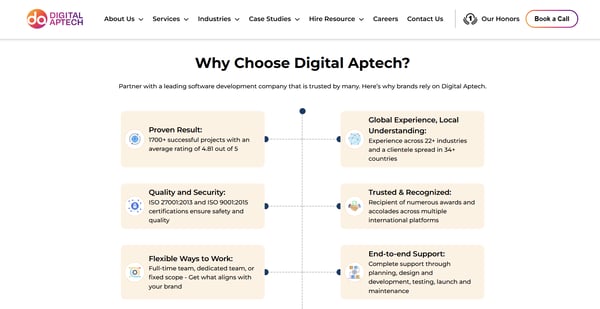
Professional conduct is a recurring theme across engagements, with transparency, reliability, and a strong work ethic described consistently across project types. This consistency tends to support longer-term partnerships rather than short-term handoffs. Organizations managing continuous development cycles often cite this reliability as a stabilizing factor in outsourced technical work.
The company’s responsiveness is equally notable, reflected in a 100% level of responsiveness score. Evaluator feedback highlights that the team remains accessible even during demanding timelines or when quick adjustments are required. This level of availability allows projects to move forward without unnecessary delays.
The team handles complex development tasks spanning mobile, backend, and design through a single partner relationship, reducing the need to coordinate multiple vendors. This breadth shows up in day-to-day delivery across sophisticated builds.
Digital Aptech's dedicated resource model allows businesses to scale development capacity as workloads shift, without committing to full-time internal hires. This flexibility is particularly visible among startups and growing companies managing variable project demands. Access to skilled developers without long-term overhead makes a practical difference at this stage of growth.
Engagements are typically supported by consistent timelines, organized workflows, and defined management practices, including regular meetings and progress tracking. This operational discipline keeps stakeholders and development teams aligned across the full project lifecycle. Teams managing multi-phase builds tend to find that this structure reduces coordination overhead as projects scale.
Many G2 users notice that cross-border payments can involve extra bank verification steps that occasionally delay the start of financial transactions. Organizations running projects across borders are most likely to encounter this during initial setup phases. Once the process is familiar, most teams find the payment side settles into a predictable rhythm that doesn't disrupt the wider engagement.
Interim milestones can occasionally slip during complex project phases. Teams managing tightly scheduled delivery cycles are most likely to feel the impact when mid-project timelines shift. G2 reviewers note that the team consistently makes up for delays, keeping overall delivery on track without compromising the final outcome.
Overall, Digital Aptech is positioned as a dependable development partner for organizations that need technical depth, responsive communication, and flexible resourcing across mobile and backend projects. For teams that want an engaged partner rather than a passive vendor, Digital Aptech presents a credible and well-regarded option in the Android development services category.
“I had an amazing experience working with Digital Aptech! Their team is highly skilled, professional, and incredibly responsive. From the initial consultation to the final launch, they understood my vision and executed it flawlessly. The website they developed is fast, user-friendly, and visually stunning. They also provided excellent post-launch support, ensuring everything runs smoothly. I highly recommend them to anyone looking for top-tier web development services."
- Digital Aptech review, Sidhartha G.
“The main challenge has been sending payments, as my bank’s security processes sometimes make transferring money to them difficult. Extra verification steps or holds can delay payments, which adds friction to an otherwise smooth working relationship.”
- Digital Aptech review, Julian H.
Tapptitude combines product strategy, UX design, and engineering into a single delivery model, supporting teams from early concept through to functional mobile products. The company is commonly engaged for MVP development, startup product launches, and complex mobile builds that need both execution discipline and strategic input.
G2 reviews frequently highlight Tapptitude’s product mindset during development engagements. The team tends to evaluate whether each element contributes meaningful value to the product. This perspective can help refine MVP scope and prioritize functionality that supports early validation. As a result, product teams often gain clearer direction when moving from concept to working application.
Structured delivery is a recurring theme across feedback, with clear expectations, organized workflows, and reliable follow-through described across project phases. This consistency reduces uncertainty when working with an external development team. Professionalism is rated 99%, reflecting what teams describe as dependable coordination throughout the build. In fact, what I noticed across Tapptitude reviews is that the PM quality is what makes the product mindset real. Reviewers describe being guided through decisions, not just kept updated on timelines.
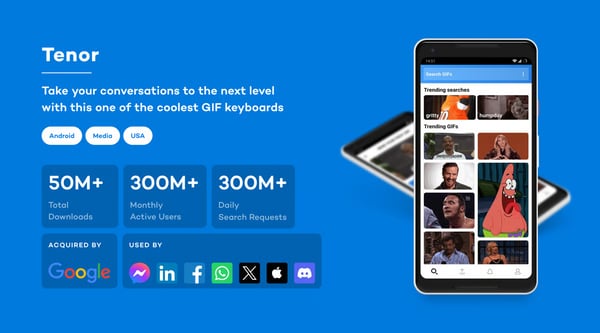
Fast response times and accessible communication channels are flagged regularly when technical questions or requirement changes arise. Teams report that this keeps development momentum steady during fast-moving cycles, a pattern that holds across 97% of communication skills ratings in the category, where Tapptitude sits just above the benchmark.
The engagement model brings developers, designers, and product specialists into the same project structure. This removes the need to coordinate across multiple vendors when design, engineering, and planning decisions intersect. Teams building complex mobile products find this consolidated setup reduces both oversight load and integration risk.
Tapptitude's delivery model is built around iteration rather than fixed feature sets, making it well-suited for teams that expect their roadmap to shift as user feedback comes in. Startups operating in fast-changing markets tend to find this structure easier to work within than more rigid delivery approaches. The focus stays on validation and user value before functionality is scaled.
G2 reviewers flag timeline slippage on larger projects with multiple dependencies as a pattern worth factoring into planning. Teams running tightly scheduled rollouts are most likely to feel the impact when mid-project priorities shift. Tapptitude's handling is consistently described as proactive, with the team working to close the gap rather than leaving clients to manage the fallout.
Time zone differences slow the question-and-answer cycle during active development, which G2 reviewers flag as a recurring friction point rather than an isolated inconvenience. Teams operating more than 10 hours apart find critical decision points take longer to resolve when working hours barely overlap. Most reviewers note that Tapptitude's evening availability reduces the drag considerably once both sides settle into a rhythm.
Taken together, Tapptitude suits organizations that want a development partner invested in product thinking, not just feature delivery. For the teams that need both strategic input and dependable engineering execution, Tapptitude is a strong option in the Android development services category.
"What I value most about Tapptitude is their product mindset combined with strong execution. They don’t behave like a feature factory. They challenge assumptions, push back when something does not add value, and keep the focus on what actually matters for an MVP. At the same time, they are structured, reliable, and pragmatic in delivery, which reduces execution risk. In practice, that means clearer decisions, fewer distractions, and steady progress toward a product that is both usable and scalable."
- Tapptitude review, Kristof D.
"The only downside encountered so far has been related to delays in rolling out a bigger project, with multiple dependencies. I would still recommend Tapptitude, due to their positive and professional attitude in remedying this issue."
- Tapptitude review, Vlad A.
Chetu provides custom software development services across mobile, web, and enterprise applications, operating as an extended engineering partner for organizations that need to expand development capacity without growing internal teams permanently.
Chetu teams are frequently described as functioning like an extension of an internal engineering department rather than an outside vendor. Dedicated developers, project managers, and technical specialists integrate directly into existing workflows. This structure helps organizations scale capacity quickly without the overhead of permanent hiring.
Technical coverage spans mobile, web, and enterprise software environments, allowing organizations to manage diverse product requirements through a single partner relationship. This breadth is particularly valuable when projects involve several technical layers that would otherwise require multiple vendors. Teams report cleaner coordination and fewer handoff gaps as a result.
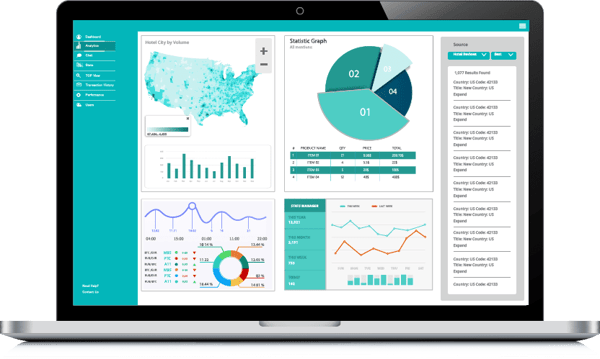
G2 reviews points to Chetu teams actively participating in development discussions rather than simply executing assigned tasks. Teams describe the collaboration as involving fresh ideas, proactive feedback, and genuine investment in project outcomes. This engagement style tends to produce stronger results than a purely directive vendor relationship.
Organizations engage Chetu most often when internal engineering capacity becomes constrained, and project momentum needs to be maintained. Teams describe delivery as efficient once the working relationship is established, with one reviewer noting a developer became highly productive within a short period, a pattern that holds across engagements, at 86% satisfaction rating for the ability to execute.
Chetu teams are consistently described as punctual, organized, and dependable across project phases, with regular meetings, progress reports, and task coordination keeping both sides aligned. This operational structure supports longer partnerships where continuity and consistent delivery matter. A 91% professionalism rating in G2 Data backs up what teams describe in practice.
Adjusting team composition mid-project can require additional coordination, particularly when organizations need a resource change quickly. G2 reviewers note this process takes more effort than expected, though the right resource is usually secured with some persistence. Teams planning for longer engagements where resource needs evolve gradually tend to find this less disruptive than those expecting immediate changes.
Pricing requires detailed scoping during project planning rather than selecting from fixed packages, which G2 reviewers flag as an added step when timelines are tight. Organizations with clearly defined requirements tend to navigate this more smoothly than teams still shaping their project scope. The custom scoping approach generally produces engagements that align more closely with actual project needs once the process is complete.
Altogether, Chetu offers scalable engineering support and broad development expertise for organizations managing complex software initiatives. For companies that need to extend internal teams with experienced external developers, Chetu remains a relevant and well-adopted option in the Android development services category.
“I value Chetu's expertise. They're able to write HIPAA-compliant software very quickly, accurately, and in an affordable fashion. They allowed us to have a HIPAA-compliant portal that doctors could access. I appreciate the cost and quality of their product, which encourages me to continue or expand our partnership.”
- Chetu review, Eric D.
“Sometimes, to get a different resource can be a bit of a hassle, but usually we are able to get what is needed with a little more persuasion.”
- Chetu review, Dan C.
Wolfpack Digital focuses on building mobile and web applications through close collaboration with client teams.
Organizations frequently reference their ability to combine technical execution with clear communication throughout the development lifecycle. The company is commonly associated with projects that require native mobile expertise, structured planning, and ongoing product collaboration.
Teams consistently describe communication as one of Wolfpack Digital’s clearest strengths. What I saw in the reviews was a strong sense of visibility, with clients saying they stayed informed on progress, upcoming milestones, and possible issues before they turned into blockers.
What stood out to me was the follow-through. I kept seeing mentions of detailed call reports, clear written summaries, and early heads-ups when challenges came up, which made the communication feel genuinely useful rather than routine; a pattern that holds consistently across a 98% professionalism rating.
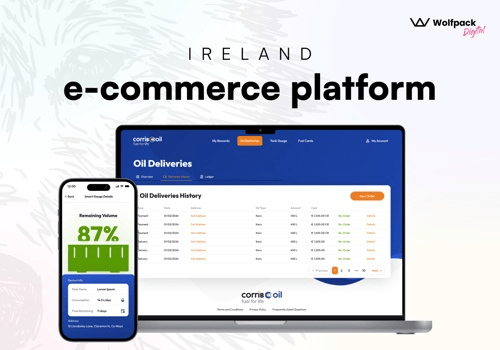
Technical depth shows up in how the team handles complex builds, taking ownership of architecture and platform decisions without requiring clients to document every detail. Reviewers describe a team that internalizes the product quickly and corrects course when needed. The 98% expertise of team rating reflects what teams describe as lean, focused development that delivers strong fundamentals.
Projects are organized around defined timelines, clear work packages, and transparent development milestones. This planning structure helps stakeholders maintain visibility across project phases. When requirements evolve, the structured approach helps teams adapt while maintaining delivery clarity.
Wolfpack Digital appears adaptable in structuring development engagements around specific project needs. Review data suggests that service agreements and resource structures are often adjusted to fit evolving product requirements. This flexibility allows organizations to maintain momentum when project scope expands or priorities shift.
Operational collaboration tends to remain straightforward throughout projects, with reviewers describing a working relationship that feels accessible and well-coordinated even across distributed teams. This consistency supports smoother coordination during longer development cycles where remote partnership reliability matters most.
Pricing sits higher than development partners in lower-cost regions, which G2 reviewers acknowledge as a consideration during budget planning. Reviewers who prioritize experienced engineering and structured delivery consistently describe the cost as reflected in what gets built.
Time zone differences create scheduling friction during active development phases, which G2 reviewers flag as the most consistent operational challenge. Teams requiring real-time collaboration across significant offsets find that some discussions need early or late availability from one side. Most find the working rhythm settles once async communication practices are established early in the engagement.
Wolfpack Digital presents a development partner centered on communication-driven collaboration and mobile expertise. For organizations building mobile applications that require both technical execution and ongoing collaboration, Wolfpack Digital remains a relevant option within the Android development services category.
"Dedicated product owner from their end who really took ownership and developed a real understanding of the business and its needs.
Delivery was mostly on time; any slight delays were always due to third-party complications.
Responses were always above and beyond, even outside of normal working hours.
Communication and hands-on problem solving."
- Wolfpack Digital review, Damian B.
“Anything I dislike about Wolfpack stems from it being an outside team. They collaborate super well, but there is some time lost with the back and forth of finding an issue, reporting the issue, working to make sure the issue is understood, and then getting it fixed. If there are many stakeholders in the project (an issue on our side :), it can slow down development."
- Wolfpack Digital review, Joshua D.
Built around collaborative engineering workflows, Teravision Technologies provides dedicated development teams that support Android product development, feature expansion, and infrastructure modernization.
Teravision’s engagement model emphasizes structured development processes that help teams maintain predictable delivery timelines. Regular communication rhythms and sprint-based collaboration help internal stakeholders stay aligned with external engineering teams throughout development cycles. This structure contributes to steady product iteration and consistent feature rollouts.
Quick follow-ups and proactive coordination during active development phases are flagged consistently across feedback. Teams report that requests are addressed promptly, keeping product development moving without unnecessary delays. The rhythm of responsiveness across engagements sits at 99%, reflecting what reviewers describe as a team that stays accessible throughout the project rather than only at scheduled checkpoints.
Teravision's engineers are consistently described as technically capable across both new product builds and existing application enhancements. Organizations reference support for expanding platform functionality while maintaining stability across releases. The expertise of the team is rated 98%, backing up what review patterns describe as deep engineering coverage across Android development contexts.
Reliability and structured collaboration come up often in longer engagements, with reviewers pointing to clear communication and steady delivery across multiple phases. What I noticed in Teravision Technologies reviews was how the team handled changes without making the process feel harder than it needed to be.
Reviewers frequently connect Teravision's sprint-based model with faster release cycles, describing incremental functionality delivered consistently across product versions. This execution discipline helps organizations bring new features to market without waiting for large batch releases. The structured approach keeps delivery predictable even as product requirements evolve between sprints.
Beyond application development, feedback highlights Teravision's support in modernizing infrastructure environments, including migrating systems to scalable cloud architectures like AWS and implementing DevOps workflows. These capabilities help organizations strengthen platform reliability while preparing for future product growth. Teams building or evolving Android products find this infrastructure depth useful as products scale beyond initial launch.
G2 reviewers flag that engagements typically involve a full team structure, analysts, scrum masters, and technical leads, rather than individual contributors. Teams with narrower or more contained scopes may find this setup more extensive than the task requires. For organizations running complex or multi-phase development, this structured composition supports stronger planning oversight and more organized delivery throughout the engagement.
Staff continuity across longer partnerships has historically been a consideration, with G2 reviewers noting periods of higher turnover in extended engagements. Reviewers note that turnover has reduced considerably in recent periods, with continuity improving noticeably over the past year.
Teravision Technologies aligns well with organizations seeking collaborative engineering support and steady product delivery cycles. For organizations prioritizing reliable execution and long-term engineering collaboration, Teravision presents a credible and well-regarded option in the Android development services category.
“Teravision has significantly improved our efficiency. In addition, Teravision has proven to be a reliable and committed partner, always willing to adapt to our needs and provide us with innovative solutions to improve our operation.”
- Teravision Technologies review, Liam A.
“ Sometimes we need hands to work, and having to get a complete team (analysts, leaders, scrum masters, etc.) seems to be a bit much.”
- Teravision Technologies review, Ezra H.
|
Company |
G2 rating |
Free plan |
Best for |
|
Digital Aptech |
4.9/5 |
No |
Flexible Android development with dedicated teams |
|
Tapptitude |
4.9/5 |
No |
Product-focused Android development and MVP execution |
|
Chetu |
4.0/5 |
No |
Large-scale development partnerships and extended engineering teams |
|
Wolfpack Digital |
4.7/5 |
No |
Collaborative mobile app development |
|
Teravision Technologies |
4.9/5 |
No |
Agile Android development |
Got more questions? G2 has the answers!
Digital Aptech and Tapptitude are most often associated with a strong price-to-value balance among the five providers. Clients highlight consistent delivery, responsive communication, and the ability to maintain quality without the overhead of large enterprise development contracts.
For healthcare and regulated industry Android development, Chetu and Teravision Technologies are the strongest fits. Chetu covers fintech, healthcare, and enterprise builds through an extended team that integrates directly into existing workflows. Teravision brings sprint-based delivery and infrastructure depth that suits organizations managing compliance-sensitive development across multiple release cycles.
Teravision Technologies and Wolfpack Digital appear most frequently in discussions around long-term Android development partnerships. Reviews emphasize structured development processes, reliable post-launch support, and the ability to maintain applications as products evolve.
Tapptitude and Digital Aptech surface most often in reviews from smaller organizations building their first Android applications. Teams value clear communication, manageable project scopes, and development workflows that support rapid product iteration.
Wolfpack Digital is most frequently highlighted for visually polished, user-focused mobile products. Review feedback consistently mentions strong design collaboration and mobile UX expertise, which matter most for engagement-driven applications where interface quality directly affects retention.
Tapptitude appears most often in reviews from startups focused on rapid MVP development. Teams describe streamlined development processes, strong product design input, and the ability to move quickly from concept to working mobile prototype without losing strategic focus.
Chetu and Teravision Technologies are most frequently mentioned for custom enterprise Android applications. Reviews highlight experience building specialized tools, integrating backend systems, and supporting internal business workflows at scale.
Chetu and Wolfpack Digital are most often referenced for fintech and compliance-sensitive mobile applications. Review feedback highlights experience with secure architecture, payment integrations, and regulated industry requirements.
Chetu is the strongest option when security and compliance are central requirements. Its dedicated developers integrate directly into client workflows and cover compliance-sensitive environments across fintech and regulated industries from the start of the engagement.
Teravision Technologies and Digital Aptech are most often evaluated for scalability and long-term support. Teravision's sprint-based model supports continuous feature delivery as products grow, with infrastructure modernization capabilities that extend beyond initial app development. Digital Aptech's dedicated resource model shifts between contained and scaled engagements as resourcing needs evolve.
Android development decisions rarely stay confined to engineering. They shape how quickly features reach users, how reliably the app performs under real-world demand, and how smoothly the product evolves as new requirements emerge. In most organizations, the development partner sits directly between product strategy and execution. When that partnership works, teams release updates with confidence and maintain momentum. When it doesn’t, delays, unstable builds, and constant coordination issues start slowing everything around the mobile roadmap.
The strongest Android development partners share one consistent quality: discipline across the development lifecycle. They maintain structured release pipelines, communicate clearly when priorities change, and build applications that remain stable as new features are layered in. When those elements are missing, the consequences tend to compound quickly.
Choosing Android developers, therefore, is less about comparing capabilities and more about reducing execution risk across the entire mobile product lifecycle. The right partner strengthens how your organization designs, ships, and improves its Android experience over time. When that alignment exists, development stops feeling like a constant operational hurdle and instead becomes a dependable engine for product progress.
Need a reliable development partner? Compare leading software developer service providers on G2 and find the right team for your next project.


If you’re evaluating the best ad network software, this isn’t a category you’re exploring;...
 by Gunisha

Onboarding is where retention is won or lost, and most teams don't have the right system to...
by Disha C
If you are comparing for the best standard operating procedures software, process breakdowns...
by Disha C