

-3.png?width=1200&name=dark%20(11)-3.png "dark (11)-3")
AI voice assistants are no longer an experiment; the software is fully operational for over half of users, and popularity is accelerating across all industries and segments.
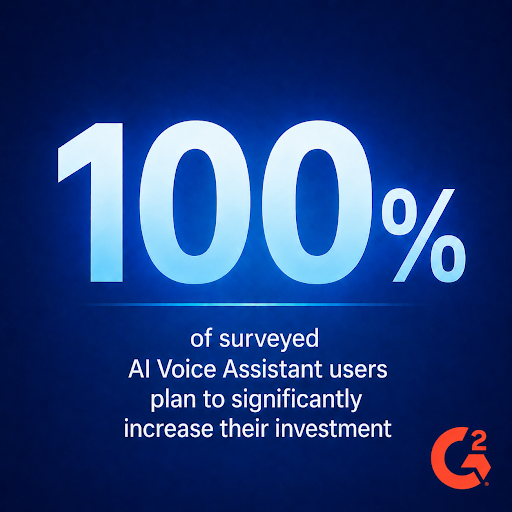
G2 analyzed verified reviews and gathered responses from 17 leading AI vendors to understand how AI voice assistants are performing in real-world environments. The data reveal that software adoption is soaring, and even though 100% of survey respondents expect to significantly increase their investment, the ability to demonstrate its value and ROI hasn't kept pace.
This report combines G2's proprietary review data with structured input from 17 leading AI Voice Assistants vendors. G2 review data reflects verified buyer experiences, whereas Vendor insights represent platform-level observations.
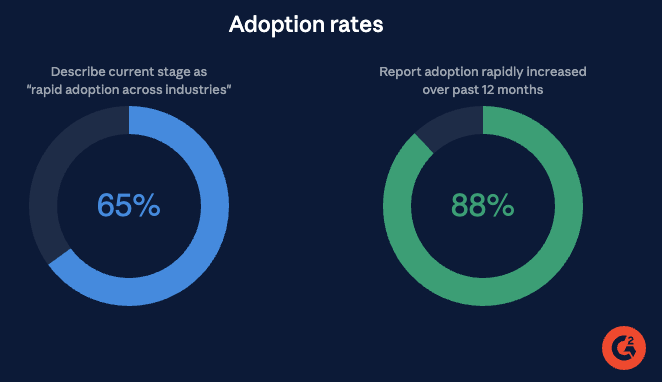
Our survey data shows that 65% of platform users describe the current industry stage as "rapid adoption across industries", and 88% report that adoption rapidly increased over the past 12 months alone. This signals that this category is already quite mainstream, despite its relatively young age.
“We're past the tipping point. Voice AI agents aren't experimental anymore. They're how modern businesses communicate with customers at scale. The companies investing now are building a durable competitive advantage, and the ones waiting are falling behind every month.”
Evie Wang
Co-Founder & CMO, Retell AI
What’s interesting about this fast adoption is that companies with fewer than 10 employees (SMB) represent the single largest reviewer segment, while enterprise organizations account for just 59 reviews combined. Voice AI assistants didn't get adopted because large companies were early trend-setters and spreading the word. It gained popularity because smaller organizations that probably didn’t have to cut through the purchasing red tape with a procurement team, multiple approvals, etc., were advocates of the software and were able to easily buy and implement it.
When a category grows this fast from the “bottom up”, I believe it signals one of two things: either the technology is solving a legitimate problem at a low barrier to entry, or expectations are outpacing reality. In the case of AI voice assistants, the data points to the former. The category averages a 9.26 out of 10 user recommendation score from 1,419 reviews, an unusually high score for a market still rapidly growing. Our data shows that the software is definitely meeting users' expectations, and now organizations need to incorporate and scale to meet their customers' needs to stay competitive.
“We've seen massive organizational transformation where voice is starting to become the default way in which people work. Most of the fastest-growing companies now have Wispr Flow as their daily driver, and we're seeing incredible demand where over 1,000 companies are signing up every single month.”
Tanay Kothari
CEO, Wispr Flow
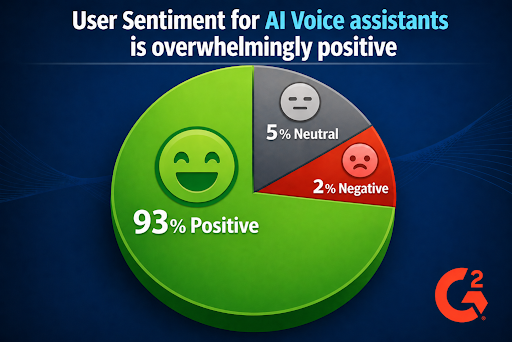
User sentiment from the market is nearly unanimous. Across 1,419 verified G2 reviews, 93.1% of buyers express positive sentiment by rating their AI voice assistant experience 4 stars or above (out of 5). Just 4.9% are neutral, and only 2.0% are negative.
“AI voice assistants have moved from simple call deflection to handling real customer conversations with more context, judgment, and action. The future belongs to voice AI that can understand messy real-world speech, connect to enterprise systems, and work alongside human agents.”
John McMullan
Director of Product Marketing, Observe.AI
For a category still growing and experiencing real infrastructure challenges, that level of satisfaction is impressive.
On the positive side, buyers consistently highlight ease of setup, the quality of voice agents, and time savings in customer support. On the not-so-positive side, the pain points are pricing at scale and gaps in features cited most frequently. However, reviewers use the words "would" and "could" a lot, which feels more like suggestions, rather than outright criticism or dissatisfaction. They're buyers who see the potential and want more of it.
Structured input from our survey and user reviews helps us understand what buyers are prioritizing, and why. A couple of common themes, as demonstrated by actual user quotes below, show where they are finding ROI in simple, day-to-day operations, such as tickets and queues, not through large, complicated projects. As well as how they are unlocking ROI with quick onboarding and deployment, and a low barrier to entry. But again, the challenge is having the right tools to prove the ROI is there.
Theme 1: Delivering ROI through self-service.
“Voice is the most human interface we have. The bar for AI in that channel isn't functional — it's seamless. Natural. Trustworthy. The enterprises that get there will be the ones that stopped asking how much they could automate and started asking what their customers actually deserve.”
Andrei Papancea
CEO & Co-Founder, NLX
Theme 2: Quick deployment/onboarding.
“The word 'assistant' is about to become obsolete. We now have voice agents that execute complete workflows: verify identity, process payments, flag fraud — all in one call. No transfers, no hold music.”
Daniel Gesser
VP of Marketing, Engageware
The data from our vendor survey shows us that the market has already made up its mind. AI voice assistants are no longer being evaluated as a “nice to have” software; companies are actively buying, using, and scaling them. The question for most organizations in 2026 isn't whether voice AI works. It's whether they're moving fast enough to keep up with the companies that have already figured this out.
“Enterprises must rethink their call center operations. Organizations that adopt AI phone agents will gain a competitive advantage by improving customer satisfaction and retention while increasing operational efficiency. Those that don't risk being outpaced by faster, more responsive, competitors.”
Isaiah Granet
CEO & Co-Founder, Bland.
For buyers, two things stand out clearly. First, the ROI is real, but it's being seen before it's being measured. Organizations are experiencing operational gains, such as faster response times, reduced support costs, and self-service that actually works, but most still lack the tools to measure what they know is happening. For buyers who have already deployed voice AI and haven't invested in a way to measure this, that's the gap to close next. The value is there, but they need to clearly see it to prove it, defend it, and expand on it.
“The real shift is moving from scripted, transactional experiences to conversations that actually feel natural and get things done. The value comes when you combine strong language capabilities with connected data and systems — so you're not just understanding intent, you're resolving it end-to-end.”
Rebecca Roberts
Senior Director PMM, Genesys
Second, the barrier to entry seems to be very low, but the barrier to scale is higher. The data shows that buyers are getting the software up and running quickly, often without adding headcount. The initial deployment isn’t the issue; it's integrating voice AI into existing infrastructure, aligning it to disparate data, and getting organizational buy-in (proving ROI) to move from the pilot stage to full deployment and usage.
“The future of voice AI isn't about sounding more human. It's about being more useful, faster. Customers don't remember the voice. They remember the first moment they felt relief. The companies that win will be the ones whose voice agents can take safe, meaningful action within seconds of a call starting. Not just answer questions, but actually move the situation forward. That requires real orchestration: the ability to carry context, respect policy, and coordinate across systems in real time. Voice is becoming a live execution layer for the business, and the organizations that treat it that way, with the same rigor they apply to any production system, will define what great service sounds like.”
Maria Ortiz
Head of Marketing, Rasa
For buyers evaluating AI voice assistants today, the market data has already validated the category and its ROI, and that satisfaction is high across every segment. The only risk now for buyers isn’t whether to adopt, but to wait any longer.
Compare top AI voice assistants software, satisfaction scores, features, and more with G2’s Spring 2026 Grid Report.


We often think of artificial intelligence (AI) as a tool for automating tasks or crunching...
 by Soundarya Jayaraman
If you’ve sat through even one SaaS demo in the last year, you’ve heard the pitch.AI sales...
 by Yukta Rustagi
Key Findings The market is driven by individual users and small businesses. 70% of reviewers...
 by Alanna Iwuh