


AI can already handle 25% of all work tasks across the US economy. For most workers, AI job displacement isn't a distant projection; it's a shift that's already quietly underway.
AI at work has moved from curiosity to utility to concern in just a few years. What once felt experimental now raises a real question: is this helping me, or replacing me?
Much of this change is driven by the rapid adoption of generative AI tools, which are taking over tasks that previously required time and manual effort, whether it's drafting content, handling customer queries, or assisting with code.
You can already see this in how software is evolving. In early 2026 alone, G2 introduced 11 new software categories, including 5 focused entirely on AI, with niche additions like AI interview agents and AI medical diagnostic platforms. That's a clear signal that AI is becoming a core part of workflows across industries.
And it's not just adoption; it's trust. According to G2's 2025 AI Agents Insights Report, nearly 50% of buyers would grant full autonomy to AI agents in low-risk workflows, meaning organizations are now willing to hand off decisions, not just tasks.
As a result, questions about job security and role changes are becoming harder to ignore. While headlines often focus on job loss, the reality is more nuanced. In many cases, AI isn't replacing entire jobs overnight, but is gradually reducing the amount of human effort needed.
In this article, I break down the most relevant AI job displacement statistics, including industry trends, demographic patterns, and data on AI job displacement vs. job creation. The goal is to give you a clear, data-backed view of where work is being replaced, where it’s evolving, and what that means for the workforce today.
Here’s a snapshot of where AI is most likely to displace work, based on task automation, role-level impact, and real-world adoption trends.
| Industry | Displacement signal | What it means | What does G2 review data show? |
| Administrative and data entry | Office and administrative support roles are projected to decline by 3.9% by 2034 | Data entry, documentation, and rule-based admin tasks are highly automatable | 12% of G2 reviews for workflow management software mention reduced manual work; tasks once split across a team are now handled by a single person with the right tools |
| Customer support | 70.1% of customer service tasks show AI exposure | Basic support and repetitive queries are increasingly handled by chatbots and AI agents | 60% of G2 reviews in the customer success category mention AI or automation, reflecting how central these tools have become to day-to-day support operations |
| Manufacturing and operations | Human task share in manufacturing is expected to drop from 43% to 31% by 2030 | Routine operational processes are gradually shifting to machine-led execution | 12% of G2 reviews in manufacturing intelligence tools cite AI-driven efficiency gains; and in manufacturing, efficiency gains translate directly to headcount decisions |
| Human resources | 19% of HR teams report job loss due to AI | Resume screening, interview scheduling, and coordination tasks are becoming less manual | 47% of G2 reviews in the AI agents for HR category report positive workflow impact |
| Sales | 10% of sales teams report job loss due to AI | AI is automating parts of prospecting and outreach workflows | 40% of G2 reviews in AI sales assistant tools cite efficiency gains |
| Marketing and content | 73% of marketers say their budgets are more heavily scrutinized than they used to be | Initial content drafting, basic copywriting, and repetitive campaign tasks are being handled by AI tools | 26% of G2 reviews in marketing automation mention AI handling content or campaign execution; tasks that previously required dedicated copywriters and junior creatives |
| Software development and IT | 42% of software development tasks can be automated, but a similar share is more likely to be AI-assisted | Work is shifting toward AI-supported coding rather than full replacement | In the AI IT agent tools category, 8% of G2 reviews reference AI assisting with coding or development workflows |
Now that we’ve briefly reviewed AI job displacement statistics by industry, let’s analyze what these figures signify and how AI affects each function in more detail.
To create this article on AI job displacement, I integrated global workforce research with G2 review data to reflect both the projected job impact and actual AI adoption trends.
AI automation job displacement statistics vary significantly by sector. Administrative and customer support roles face the most immediate pressure from direct task replacement. Manufacturing, HR, and sales are seeing structural changes in how work is divided between humans and AI tools. Marketing and software development are bifurcating, with volume and entry-level work shrinking while strategic and AI-specialist roles grow.
Here's a quick snapshot before we go deeper:
Administrative and data entry roles carry the highest AI-driven job displacement risk of any sector. AI systems can process documents, manage scheduling, and handle data entry faster and with fewer errors than human workers. The BLS data make this unusually concrete. This isn't a sector where demand is slowing; it's one where headcount is expected to actively shrink across the decade.
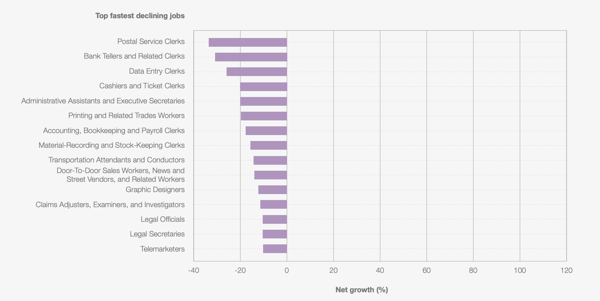 Source: Future of Jobs Report, WEF
The shift is being driven by AI tools that can handle routine queries at scale, around the clock, at a fraction of the cost of human agents. Complex, high-stakes, and emotionally sensitive interactions still need people, but those interactions represent a shrinking share of total support volume as AI absorbs the rest.
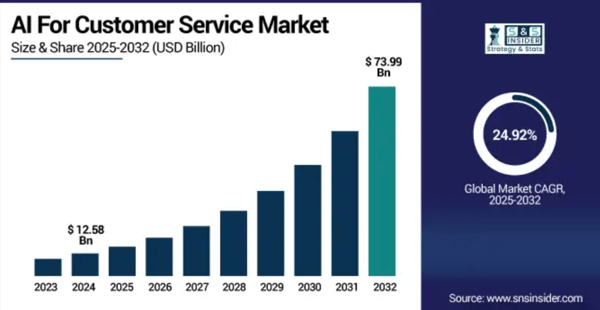 Source: S&S Insider
See how AI is redefining customer support with faster responses and smarter interactions in this G2 Report.
Manufacturing is the only sector in WEF data where the human share of work tasks is expected to fall structurally across the decade, not just in relative terms, but as a concrete shift in how work is divided. This is a second wave of disruption layered on top of decades of earlier mechanization. AI-guided robotics are more flexible and cheaper to deploy than traditional industrial robots, expanding the categories of physical work that can be cost-effectively automated.
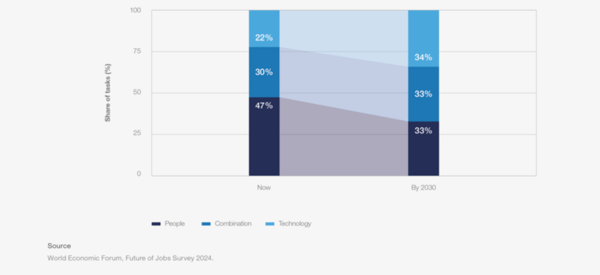
Source: WEF
HR is both an accelerator and a target. It is one of the fastest-adopting functions for AI tools: 43% of organizations now use AI in HR tasks, up from 26% in 2024, while simultaneously carrying above-average displacement exposure in its own administrative roles.
Strategic HR functions like workforce planning, culture, and employee relations are largely shielded. The job displacement due to AI in HR is concentrated in the coordination and screening layer, not the strategic one.
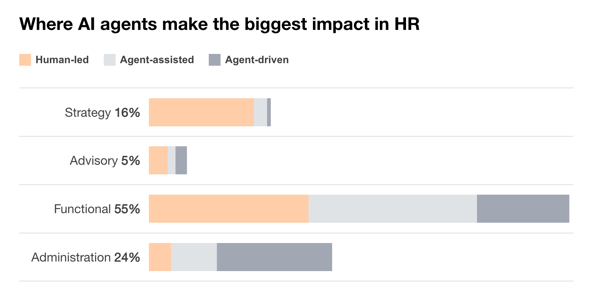 Source: PWC
Explore how HR teams are using AI to hire smarter, faster, and more fairly in this G2 Report.
The BLS 2025 employment projections flag sales as one of three occupational groups, alongside administrative support and production, where AI integration in routine calls, chats, and analysis is expected to limit demand and drive employment declines.
WEF names wholesale and manufacturing sales representatives among the roles expected to see the largest absolute employment decline by 2030.
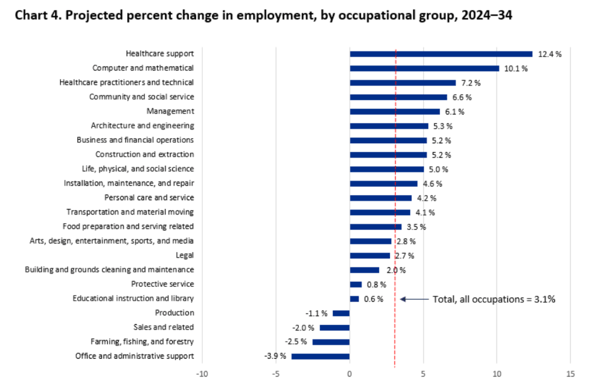 Source: BLS report
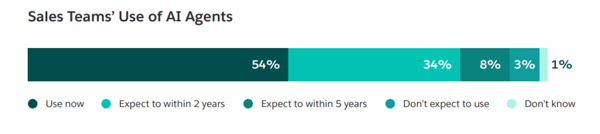 Source: Salesforce
Discover how AI is transforming prospecting from guesswork into precision targeting in this G2 Report.
In marketing, AI job displacement is mainly about increased productivity per person, the same workload handled by a smaller team. 56% of marketers say the internet is already flooded with AI-generated content, and 65% believe consumers are getting better at spotting it. The pressure is shifting toward human creative and strategic skills that AI cannot replicate.
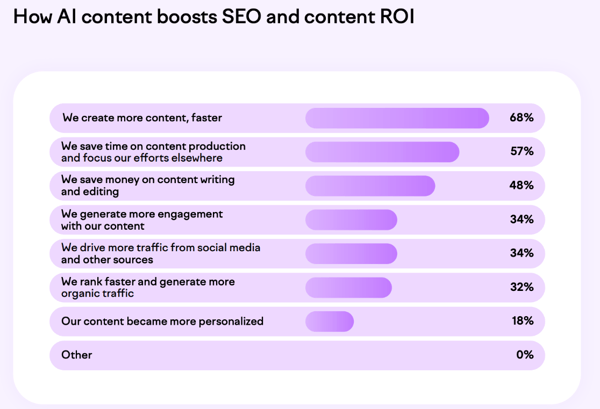 Source: Semrush
Learn how AI is helping B2B teams prioritize, personalize, and drive real pipeline impact.
J.P. Morgan reported that cloud computing, web search, and computer systems design stopped adding jobs at the end of 2022, precisely when ChatGPT launched. The AI automation job displacement in this sector is happening through hiring freezes and narrowing entry pipelines, not through developers being visibly replaced. The floor is dropping quietly, not collapsing loudly.
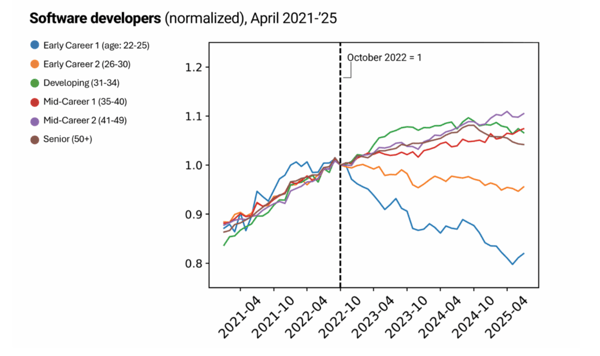 Source: ADP research
AI job displacement is not evenly distributed. The workers most affected by AI-driven job displacement are younger (22–30), more likely to be women, and concentrated in administrative, clerical, and customer-facing roles in high-income economies. Workers with AI skills are largely insulated and earn significantly more. The gap between those inside and outside the AI economy is widening across gender, age, and geography.
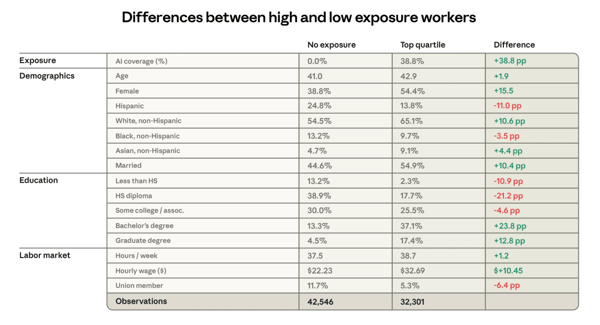 Source: Anthropic
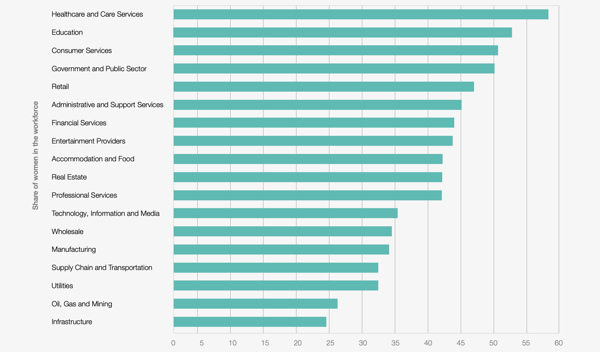 Source: Global Gender Gap Report 2025
At the global level, AI job displacement vs. creation statistics show more jobs created than destroyed; 170 million new roles projected versus 92 million displaced by 2030, a net gain of 78 million. But the jobs being created and the jobs being destroyed are not the same jobs. They require different skills, pay different wages, and appear in different places. The transition gap between displacement and accessibility is where the real challenge sits for workers.
Harvard Business School's research offers one of the most precise looks at this dynamic: job postings for the most automation-prone occupations fell 17% after generative AI launched, while postings for augmentation-prone roles, jobs where AI helps humans do more, increased 22% in the same period. The market is not shrinking; it is bifurcating.
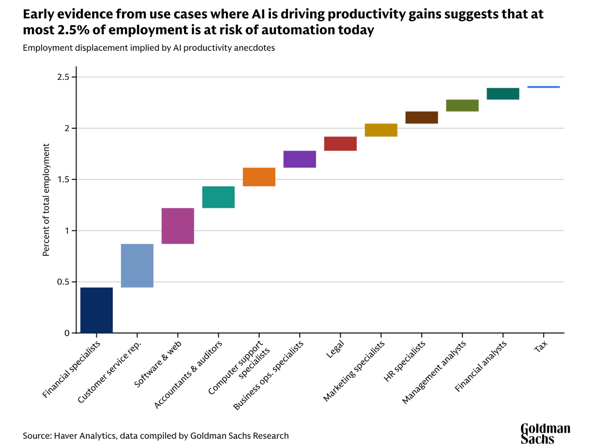 Source: Goldman Sachs
For the bigger picture on adoption, spending, and ROI, see our roundup of artificial intelligence statistics for 2026.
AI job displacement statistics show a market that is restructuring, not collapsing. The workers most at risk are younger, in entry-level or routine cognitive roles, and concentrated in administrative, customer-facing, and volume-content functions. The workers best positioned are those who can show AI skills. The question for your career isn't whether AI will affect your field. It's whether you'll be the person in your field who knows how to use it.
What is real and measurable right now: administrative roles are being automated at scale, customer support employment for young workers has already dropped, junior developer hiring has contracted, accounting firms without AI are reporting declining firm value, and marketing teams are restructuring around AI production tools.
What is also real: augmentation-prone roles are seeing 22% more job postings. Some of the fastest-growing jobs in the world didn't exist at a meaningful scale a decade ago. And the new roles being created by AI come with better pay and more flexibility than many of the roles they're replacing.
The conclusion is that the risk is not evenly distributed, and neither is the opportunity. Building AI fluency is no longer optional for workers who want to stay ahead of the curve; it's the highest-returning professional investment the data currently supports.
Unpack what it really takes to build trust in AI across teams, customers, and decisions.


Gone are the days when companies had to list open roles in newspaper ads and candidates went...
 by Mara Calvello

The job hunt isn’t what it used to be. Today, algorithms screen your résumé before a human...
by Harshita Tewari

By now, we know that AI is a fast-scaling sector.
 by Rebecca Reynoso