
April 13, 2026
/DarshayitaThakur-OrangeBG.webp?width=400&height=150&name=DarshayitaThakur-OrangeBG.webp) by Darshayita Thakur / April 13, 2026
by Darshayita Thakur / April 13, 2026
When I talk to teams evaluating governance, risk, and compliance (GRC), the challenge is rarely understanding the concept. It’s figuring out how to bring policies, risks, and compliance requirements together into one system that actually works at scale.
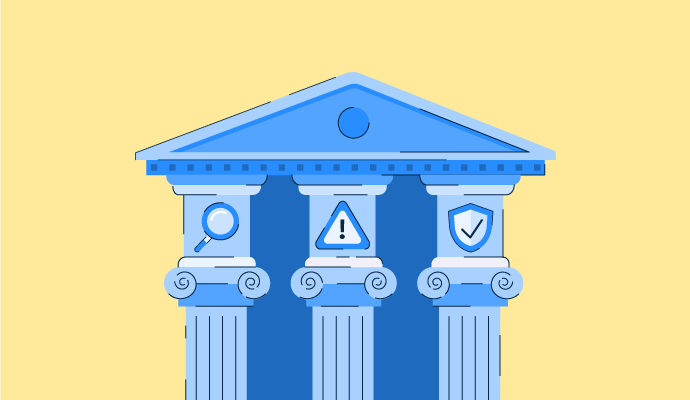
Governance, risk, and compliance is the framework organizations use to set policies, manage uncertainty, and meet internal and external requirements in a consistent way. It is not limited to audit, legal, or security teams. Governance defines how decisions are made, risk management identifies potential disruptions, and compliance ensures alignment with laws, regulations, and internal standards.
These functions are closely connected. A privacy requirement affects security controls, vendor risk involves multiple teams, and failed approvals can become audit findings. GRC brings these responsibilities into a single operating model, improving accountability and oversight.
The software landscape around GRC is equally broad. Some teams look for comprehensive GRC platforms, while others focus on audit management, enterprise risk management (ERM), security compliance automation, policy management, or business continuity tools. GRC also involves the entire organization and requires cross-departmental involvement and buy-in from entry-level employees to the C-suite.
This guide explains what GRC means, why it matters, how it works in practice, who owns it, how to implement it, and how to evaluate the software ecosystem around it.
GRC stands for governance, risk, and compliance. It is the framework organizations use to align decision-making, risk oversight, and compliance obligations in one operating model.
Instead of treating these functions as separate workstreams, GRC connects them. It links policies to processes, risks to controls, and compliance obligations to day-to-day business operations. That structure helps leaders make better decisions and helps teams work more consistently across departments.
GRC helps answer three business-critical questions:
When those questions are handled separately, organizations often end up with duplicated controls, fragmented reporting, and unclear ownership. GRC reduces that fragmentation by creating one system for oversight.
The financial and operational impact of poor governance and risk management is significant. The average cost of a data breach reached $4.4 million in 2025. Structured GRC programs help organizations reduce these risks and improve resilience.
As companies scale, they add employees, systems, cloud tools, vendors, and regulatory obligations. Each of these introduces new risks, controls, and reporting requirements. Without a coordinated GRC framework, teams often rely on fragmented processes, such as spreadsheets, disconnected tools, and inconsistent documentation. GRC replaces that fragmentation with a more structured and scalable operating model.
The demand for GRC is growing rapidly as regulatory complexity increases. The global GRC platform market is expected to grow to $44.2 billion at a CAGR of 14.2% between 2025 and 2029, driven largely by compliance requirements.
Organizations use GRC to standardize governance by establishing consistent policies, approvals, and control processes across teams while managing risk holistically across operational, financial, regulatory, cybersecurity, and third-party areas.
It also improves audit readiness by documenting controls, collecting evidence, and streamlining audit workflows, while ensuring compliance with regulatory requirements. GRC enhances reporting by providing clear insights to leadership and stakeholders and by helping track remediation efforts and maintain defensible audit trails for decisions, controls, and exceptions.
GRC also reduces the hidden cost of reactive work. Without it, teams spend significant time chasing approvals, locating documents, and responding to repeated audit requests. A structured GRC model minimizes this friction and makes compliance efforts easier to scale.
Not every organization uses GRC the same way. Use cases vary based on function, maturity, and regulatory exposure.
By team:
|
Team |
Common GRC use case |
|
IT and security |
Framework mapping, evidence collection, access control reviews, incident response documentation |
|
Legal and compliance |
Policy governance, regulatory tracking, contract-linked obligations, remediation oversight |
|
Finance |
Internal controls, reporting integrity, audit support, SOX-related oversight |
|
HR |
Policy attestations, training records, employee data controls, access lifecycle coordination |
|
Procurement and operations |
Vendor due diligence, third-party risk reviews, business continuity planning |
By company size:
|
Company type |
Best for |
|
Startups |
Building audit readiness, customer trust, and basic control documentation |
|
SMBs |
Standardizing policies, vendor oversight, and compliance workflows across growing teams |
|
Enterprises |
Centralizing governance, enterprise risk reporting, cross-functional control mapping, and board-level oversight |
By industry:
|
Industry |
Typical GRC focus |
|
SaaS |
SOC 2, ISO 27001, vendor risk, security compliance automation |
|
Healthcare |
HIPAA, privacy controls, third-party oversight, audit evidence |
|
Financial services and FinTech |
AML, regulatory reporting, vendor risk, operational resilience |
|
Manufacturing |
Business continuity, supply chain risk, operational controls |
|
Public sector and regulated services |
Policy governance, documentation, risk reporting, audit traceability |
ERM is often the starting point for mid-size teams building out a GRC program. See which ERM tools mid-size companies rate highest on G2 before expanding into the broader GRC stack.
Governance is the system of oversight that determines how decisions are made, approved, communicated, and enforced.
In a GRC context, governance is not limited to senior leadership or the board. It includes the policies, review structures, decision rights, escalation paths, and accountability mechanisms that shape day-to-day operations.
Corporate governance is the framework of rules, regulations, and practices by which a company operates. Often, a corporate governing body comprises a company’s senior leadership, board of directors, and company shareholders. They work together within a system of checks and balances to fulfill various corporate governance functions.
Strong governance establishes clear answers to critical organizational questions, including:
Governance matters because even well-designed controls fail when no one owns them. A business can invest in risk registers, audits, and policy documentation, but without governance, those elements rarely stay aligned over time.
Governance also supports corporate integrity. When organizations define expectations clearly and enforce them consistently, they create a more transparent operating environment for employees, customers, investors, regulators, and partners.
It also plays a practical role in operational speed. Teams can move faster when approval paths are clear, authority is defined, and exception handling is documented. In that sense, governance is not just about oversight. It is also about reducing uncertainty in how the business operates.
Risk management is the process of identifying, evaluating, prioritizing, and responding to uncertainties that could affect business performance, compliance posture, financial health, security, or reputation.
It is a structured process for connecting risks to business functions, likelihood, impact, controls, mitigation plans, and residual exposure.
A mature GRC program can address a wide range of enterprise risks, including:
Different departments may manage different slices of this risk landscape, but GRC creates a common language and process for evaluating exposure across the organization.
Risk management in practice usually follows a repeatable cycle:
This process helps leaders distinguish between acceptable risk, emerging risk, and material risk that requires immediate mitigation or escalation.
Inside a governance risk and compliance framework, risk management influences policy updates, audit priorities, control testing, vendor reviews, and executive reporting. That makes the function more actionable. Instead of sitting in a disconnected report, risk data drives decisions about where the organization should strengthen controls, increase oversight, or accept exposure based on business priorities.
On its own, a risk register does not improve resilience. The value comes from how risk information is used.
Compliance is the process of ensuring that the organization follows the laws, regulations, contractual obligations, and internal standards that apply to its operations.
That includes external requirements such as privacy laws, industry standards, and sector-specific regulations, as well as internal requirements such as codes of conduct, policy standards, documentation rules, and approval workflows.
Compliance becomes more complex as organizations grow because expansion introduces more regulations, systems, data, and third-party relationships that must be managed, documented, and enforced consistently.
As businesses scale, they enter new markets, adopt more software, handle larger volumes of sensitive data, and work with more vendors. Each of these adds new regulatory obligations, control requirements, and reporting expectations.
The challenge lies in translating these requirements into repeatable processes, clearly defined controls, assigned ownership, and defensible evidence that can stand up to audits.
Without structure, compliance efforts often become fragmented across teams, tools, and workflows. That fragmentation leads to duplicated work, inconsistent enforcement, and gaps in oversight.
GRC helps organizations turn regulatory requirements into standardized, repeatable operations by connecting policies, controls, risk monitoring, and evidence management into a single system.
Depending on the industry and geography, GRC programs may align with requirements or frameworks such as:
For many organizations, the priority is not one framework alone. It is the ability to map multiple obligations to shared controls and avoid duplicating work.
Governance, risk, and compliance are distinct disciplines, but they are most effective when managed as one system.
Governance defines expectations. Risk management identifies where objectives may be threatened. Compliance verifies that the organization’s behavior, controls, and documentation align with required standards.
When these disciplines operate together:
This integrated model is what gives GRC its value. It reduces duplication, improves traceability, and gives leadership a more accurate view of enterprise exposure.
When governance, risk, and compliance remain disconnected, organizations often experience:
Over time, these challenges create operational drag, as teams spend more time proving control maturity than actually improving it.
A strong GRC model assigns ownership clearly while maintaining centralized oversight.
Organizations do not need to solve every governance and compliance challenge at once. The best approach is to build a practical, scalable foundation.
Start by identifying which risks, obligations, or audit goals matter most. Then assign named owners for policies, controls, risks, and remediation. Clear accountability is the foundation of every effective GRC program.
This first step also requires setting boundaries. Are you solving for audit readiness first, vendor risk, policy governance, security compliance, or a broader enterprise risk model? Narrowing the initial scope makes the program easier to launch and easier to measure.
Create repeatable processes for policy reviews, control testing, issue remediation, audit preparation, and exception handling. Standardization reduces confusion and makes reporting more reliable. The goal is to ensure that similar issues are handled consistently, regardless of which department encounters them.
As GRC work expands, manual systems create friction. Centralizing controls, evidence, tasks, and reporting improves visibility and makes it easier to demonstrate progress.
This is often the point where organizations begin evaluating GRC tools, audit platforms, or security compliance software. When evidence lives in multiple systems and teams spend too much time reconstructing context, centralization delivers immediate value.
Instead of treating each framework or regulation as separate work, map multiple obligations to shared controls wherever possible. This helps teams reduce duplication and maintain consistency.
For example, access control reviews, change management, and security awareness training may support multiple frameworks at once. Mapping those relationships makes the program more efficient.
Risks change, regulations evolve, systems move, vendors change, and business priorities shift. Mature programs review control effectiveness regularly and update governance processes over time.
Continuous review also helps organizations move from a reactive posture to a more resilient one. Instead of discovering weaknesses only during an audit, teams identify gaps earlier and improve processes before those gaps become material issues.
GRC becomes easier to understand when tied to real operational use cases.
A well-implemented GRC program improves both resilience and efficiency.
Even organizations that understand the value of GRC often struggle to execute it consistently. The following challenges often come up.
Many GRC programs struggle because the rollout is misaligned with how the business actually operates. Common mistakes include:
Governance risk and compliance tools or software are products or systems designed to help organizations manage oversight activities in a centralized manner rather than across disconnected spreadsheets, inboxes, shared drives, and ticketing tools.
Depending on the product, these platforms can support policy management, risk assessments, control testing, evidence collection, issue remediation, audit management, reporting, and workflow automation.
Instead of spreading GRC work across multiple tools and manual processes, these GRC tools help teams manage governance, risk, and compliance in one environment.
According to G2, to qualify for inclusion in the category, a product must:
Smaller organizations may begin with manual processes. Software becomes increasingly valuable when:
A GRC framework is the underlying model that defines how an organization governs decisions, assesses risk, documents controls, and demonstrates compliance.
Software supports the framework, but it is not the framework itself. The GRC framework includes ownership structures, review processes, policies, control standards, issue management practices, and reporting expectations. The right software helps teams execute that framework more consistently.
GRC buyers often evaluate several adjacent software categories depending on whether they need stronger audit workflows, broader enterprise risk management, tighter security compliance, or more specialized policy and vendor oversight.
Before evaluating GRC products, buyers should determine whether their primary need is:
That starting point shapes the right category and shortlist.
Across categories, buyers should evaluate:
These terms are closely related and often used interchangeably, but they serve different purposes within an organization’s risk and oversight strategy.
At a high level, all three categories aim to improve control, visibility, and accountability. The difference lies in scope and primary use case. GRC is the broadest concept, while ERM and compliance software focus on more specific functions within that framework.
In practice, many organizations start by searching for GRC tools but quickly realize their immediate need is narrower, such as audit readiness, cybersecurity compliance, or enterprise risk visibility. This is why buyers often evaluate adjacent categories like Audit Management, Security Compliance, or ERM instead of a single GRC platform.
|
Category |
Focus & capabilities |
Best suited for |
Typical users |
|
GRC software |
End-to-end governance, risk, and compliance management with policy management, risk tracking, control mapping, audit workflows, and reporting dashboards |
Organizations needing a centralized oversight platform across functions |
Compliance teams, risk leaders, executives, audit teams |
|
ERM software |
Enterprise-wide risk identification and analysis with risk registers, scoring models, scenario analysis, dashboards, and forecasting |
Organizations prioritizing strategic risk visibility and decision-making |
Risk teams, executives, finance leaders |
|
Compliance software |
Meeting regulatory and framework requirements with evidence collection, policy enforcement, audit preparation, and framework mapping (SOC 2, ISO, etc.) |
Organizations focused on audit readiness, certifications, or regulatory compliance |
Compliance teams, security teams, audit teams |
GRC buyers on G2 do not just explore one category. They often move between adjacent categories based on the problem they are trying to solve.
Data governance tools are used when an organization needs to manage data quality, access, lineage, and policy enforcement across the data lifecycle.
These platforms help teams establish governance standards, improve data integrity, control permissions, and maintain visibility into where data comes from and how it moves across systems.
The top data governance tools according to Spring 2026 G2 Grid Report are as follows:
|
Software |
G2 score |
Best for |
Pricing (lowest starting point) |
|
95 |
Enterprises needing a unified data lakehouse with strong governance, analytics, and AI/ML capabilities |
Pay-as-you-go ($0.15/DBU for jobs compute) |
|
|
86 |
Teams looking to unify structured and unstructured data with built-in governance for AI and analytics |
Usage-based pricing |
|
|
84 |
Business users needing self-service analytics with built-in governance and visualization |
Usage-based pricing |
|
|
79 |
Organizations prioritizing content governance, secure file sharing, and access control |
$22 per user/month |
|
|
75 |
Enterprises focused on AI governance, model compliance, and responsible AI monitoring |
$0.64/evaluation |
Note: G2 Score is calculated as the average of Satisfaction (based on user reviews) and Market Presence (based on company size, reach, and market visibility), normalized within each category.
This category is especially relevant for teams that need stronger data oversight, metadata management, lineage tracking, access governance, and compliance support across large or distributed data environments.
Audit management software helps organizations whose main challenge is planning, conducting, documenting, and reporting on audits.
Based on the Spring 2026 G2 Grid Report, the top 5 audit management platforms are:
|
Software |
G2 score |
Best for |
|
92 |
Teams that want automated compliance workflows, continuous monitoring, and faster SOC 2 / ISO 27001 readiness with strong integrations |
|
|
91 |
Enterprises focused on audit, regulatory, financial, and ESG reporting with strong collaboration and connected reporting workflows |
|
|
91 |
Enterprises that need broad audit, risk, and compliance management with AI-assisted workflows and cross-functional GRC coordination |
|
|
74 |
Companies looking for highly automated security compliance, audit prep, and framework management across standards like SOC 2, ISO 27001, GDPR, and HIPAA |
|
|
72 |
Organizations that want automation-led security compliance management and a centralized hub for ongoing compliance operations |
Note: Pricing for these audit management platforms is available upon request. G2 Score is calculated as the average of Satisfaction (based on user reviews) and Market Presence (based on company size, reach, and market visibility), normalized within each category.
This category is often relevant for teams focused on audit workflows, corrective actions, and evidence gathering across internal and external stakeholders.
ERM software is more appropriate when the organization needs a broader enterprise-wide risk management capability rather than an audit-led workflow.
Current G2 at-a-glance positions based on the Spring 2026 G2 Grid Report include:
|
Software |
G2 score |
Best for |
|
95 |
Enterprises needing a unified ERM and GRC platform with strong audit, risk, and compliance coordination across departments |
|
|
83 |
Large organizations managing enterprise risk alongside financial, regulatory, and ESG reporting in one connected platform |
|
|
73 |
Fast-growing companies that want automated risk monitoring, compliance workflows, and continuous control tracking |
|
|
71 |
Mid-market and scaling companies looking for integrated risk, compliance, and audit readiness with strong automation |
|
|
68 |
Enterprises that need deeply customizable, workflow-driven risk management integrated with broader IT and business operations |
Note: Pricing for these ERP is available upon request. G2 Score is calculated as the average of Satisfaction (based on user reviews) and Market Presence (based on company size, reach, and market visibility), normalized within each category.
ERM tools are especially relevant when the priority is risk identification, scoring, monitoring, and reporting across business functions.
Security compliance software helps teams document and demonstrate adherence to cybersecurity frameworks such as SOC 2, ISO 27001, PCI DSS, FedRAMP, GDPR-related controls, and NIST-aligned standards.
According to the Spring 2026 G2 Grid Report for the security compliance category, the top platforms are the following:
|
Software |
G2 score |
Best for |
|
99 |
Teams that want fast, automated compliance with strong integrations and continuous monitoring for frameworks like SOC 2 and ISO 27001 |
|
|
90 |
Organizations looking for deep automation, real-time evidence collection, and scalable compliance workflows |
|
|
87 |
Fast-growing companies needing highly automated compliance, continuous control monitoring, and multi-framework support |
|
|
87 |
Companies that want structured compliance workflows, guided onboarding, and support for multiple frameworks |
|
|
82 |
IT and security teams focused on identity, access, and device management with built-in compliance alignment |
Note: Pricing for these security compliance software is available upon request. G2 Score is calculated as the average of Satisfaction (based on user reviews) and Market Presence (based on company size, reach, and market visibility), normalized within each category.
Security compliance is especially valuable for organizations that need security audit readiness, framework mapping, and automated evidence collection.
The GRC tools category captures products that do not fit neatly into other governance, risk, and compliance segments but still support governance processes, risk assessment, and compliance monitoring.
Top 5 GRC tools, according to the Spring 2026 G2 Grid Report, include:
|
Software |
G2 score |
Best for |
|
76 |
Enterprises managing global statutory reporting, e-invoicing, and regulatory compliance within ERP systems |
|
|
70 |
Organizations using Microsoft 365 that need structured records lifecycle management, retention policies, and compliance automation |
|
|
66 |
Small to mid-sized businesses looking for easy-to-use GRC tools with strong usability and fast implementation |
|
|
58 |
Organizations monitoring internal communications for regulatory compliance, risk detection, and policy enforcement |
|
|
48 |
Education and enterprise teams focused on user activity monitoring, safeguarding, and compliance visibility |
Note: Pricing for these GRC tools is available upon request. G2 Score is calculated as the average of Satisfaction (based on user reviews) and Market Presence (based on company size, reach, and market visibility), normalized within each category.
This category can be useful for teams looking for broad or specialized governance and compliance capabilities outside a narrower category definition.
Business continuity management software becomes relevant when the organization’s priority is resilience planning, response coordination, and recovery readiness.
According to the Spring 2026 G2 Grid Report for this category, the top platforms are the following:
|
Software |
G2 score |
Best for |
Pricing (lowest starting point) |
|
72 |
Teams focused on operational resilience, inspections, incident tracking, and frontline risk management |
$24/user/month |
|
|
69 |
Enterprises needing large-scale incident response, crisis management, and real-time event coordination |
Custom pricing |
|
|
69 |
Companies combining business continuity with security compliance, audit readiness, and continuous monitoring |
Custom pricing |
|
|
67 |
Enterprises requiring integrated risk management, business continuity, and regulatory compliance in one platform |
Custom pricing |
|
|
59 |
Small to mid-sized teams looking for simple, collaborative business continuity planning and recovery workflows |
〜$270/month |
Note: G2 Score is calculated as the average of Satisfaction (based on user reviews) and Market Presence (based on company size, reach, and market visibility), normalized within each category.
These BCM tools are useful for teams that need structured resilience planning, coordinated incident response, and faster recovery from operational disruptions.
Anti-money laundering software is most relevant for organizations with customer verification, transaction monitoring, sanctions screening, or financial crime obligations.
According to the Spring 2026 G2 Grid Report for this category, the top 5 anti-money laundering software are as follows:
|
Software |
G2 score |
Best for |
Pricing (lowest starting point) |
|
85 |
Businesses needing fast identity verification, KYC onboarding, and fraud prevention with strong automation and global coverage |
$1.35 / verification |
|
|
82 |
Companies focused on identity verification, AML screening, and fraud prevention with high accuracy and ease of use |
$0.58 / verification |
|
|
72 |
Financial institutions requiring robust AML monitoring, transaction analysis, and regulatory reporting workflows |
Custom pricing |
|
|
70 |
Organizations looking for AI-driven AML, KYC, and identity verification with strong compliance automation and ease of implementation |
$249/month |
|
|
70 |
Enterprises needing comprehensive risk intelligence, sanctions screening, and due diligence data for global compliance programs |
Custom pricing |
Note: G2 Score is calculated as the average of Satisfaction (based on user reviews) and Market Presence (based on company size, reach, and market visibility), normalized within each category.
Third-party and supplier risk management software is designed for organizations that need to assess, monitor, and mitigate risks introduced by vendors, suppliers, and other external partners.
These platforms help teams manage a broad range of third-party risks, including financial, legal, strategic, reputational, ethical, operational, cybersecurity, environmental, and geopolitical exposure.
The top 5 platforms, according to the Spring 2026 G2 Grid Report include the following:
|
Software |
G2 score |
Best for |
|
92 |
Teams that want automated vendor risk assessments, continuous monitoring, and compliance-aligned third-party oversight |
|
|
91 |
Organizations needing continuous vendor risk monitoring, external security ratings, and real-time threat intelligence |
|
|
79 |
Companies focused on trade compliance, sanctions screening, and regulatory checks during vendor onboarding |
|
|
77 |
Businesses looking to automate vendor risk reviews alongside broader compliance and audit workflows |
|
|
72 |
Enterprises needing scalable, integrated third-party risk management within a broader GRC and ERM platform |
Note: Pricing for these third-party and supplier risk management software is available upon request. G2 Score is calculated as the average of Satisfaction (based on user reviews) and Market Presence (based on company size, reach, and market visibility), normalized within each category.
This category is most useful for buyers who need continuous vendor oversight, structured third-party risk assessments, and stronger protection against supplier-driven operational, compliance, and reputational risk.
In G2’s Best Governance, Risk & Compliance (GRC) products for 2026 list, the top five products are Vanta, Workiva, Sprinto, Secureframe, and Optro. The ranking reflects buyer feedback across 1,703 total products in the category, with 111 eligible for the 2026 awards.
The best choice depends on the problem the organization needs to solve first.
|
Software type |
When to choose it |
Primary focus |
|
Audit Management software |
When audit planning, evidence collection, and post-audit issue tracking are key challenges |
Audit workflows, documentation, and remediation tracking |
|
Enterprise risk management (ERM) software |
When leadership needs enterprise-wide risk visibility and structured risk reporting across departments |
Risk identification, scoring, monitoring, and reporting |
|
Security compliance software |
When the priority is meeting frameworks like SOC 2, ISO 27001, or PCI DSS and automating evidence collection |
Framework alignment, security controls, and audit readiness |
|
GRC platforms (broad tools) |
When you need a centralized system for governance, risk, and compliance that doesn’t fit a single category |
Unified oversight, policy management, and cross-functional coordination |
|
Business continuity management or third-party risk tools |
When resilience planning, vendor risk, or operational continuity is the primary concern |
Incident response, recovery planning, and vendor risk management |
GRC software pricing varies widely based on company size, use case, and implementation complexity. In general, pricing ranges from a few thousand dollars for smaller teams to six-figure investments for enterprise deployments.
Most vendors do not publish fixed pricing and instead offer custom quotes based on organizational needs and scope.
GRC platforms are typically priced using one or more of the following models:
Several factors influence total cost:
The total cost of GRC software goes beyond the subscription price. Manual effort, audit preparation time, and fragmented tools often create hidden costs that can exceed the platform investment.
In many cases, investing in the right GRC platform reduces long-term costs by improving efficiency, audit readiness, and cross-functional visibility.
Got more questions? G2 has the answers
No, GRC is relevant for organizations of all sizes, especially those handling sensitive data, scaling operations, or preparing for audits and regulatory requirements.
The three pillars of compliance management are often described as people, processes, and technology, which define how compliance is executed. Within a GRC framework, these align with governance, risk management, and compliance activities.
UpGuard is often the best choice for SMBs because it offers easy setup and continuous monitoring of vendor security posture, helping teams gain visibility quickly without heavy implementation effort. Vanta is a strong alternative for startups and fast-growing companies that want to manage vendor risk alongside compliance frameworks like SOC 2 or ISO 27001 in a single platform.
SafetyCulture is one of the best value-for-money options because it offers a free tier, low starting price, and a mobile-first design that makes it easy to deploy across teams quickly with minimal training.
You can find verified user reviews, ratings, and comparisons of top GRC platforms on G2, including tools commonly used in financial services.
Optro is one of the best choices for mid-sized companies because it’s specifically designed to manage audit, risk, and compliance in a single connected system, reducing duplication and making it easier to scale as requirements grow.
Start by defining scope and ownership, standardizing workflows, centralizing controls and evidence, mapping requirements to controls, and continuously reviewing and improving the framework.
Vanta, Drata, Scrut Automation, and Secureframe are all strong cloud-based GRC platforms for multi-framework compliance. They allow organizations to map a single set of controls across standards like SOC 2, ISO 27001, HIPAA, PCI DSS, and GDPR, reducing duplicate work.
Vanta and Drata stand out for their automation and ease of mapping controls across frameworks, while Secureframe offers more structured workflows. Scrut Automation is a good fit for scaling companies that need risk, audit, and compliance management alongside multi-framework support.
GRC is a broad framework that covers governance, risk management, and compliance across the organization, while IT audit is a specific function that evaluates the effectiveness of IT controls and systems within that framework.
Databricks, IBM watsonx.data, Domo, and Egnyte are among the top-rated data governance platforms for cloud migration, as they offer strong integration with cloud data platforms, scalable governance controls, and support for analytics and AI workloads.
GRC is a coordinated operating discipline that helps organizations govern effectively, manage uncertainty, and meet obligations with consistency.
When governance, risk management, and compliance are integrated, organizations gain a more reliable way to assign accountability, monitor exposure, document controls, and improve operational resilience over time.
For buyers evaluating software, the most important step is to define the primary problem first. Some organizations need stronger audit workflows. Others need enterprise risk visibility, security compliance automation, business continuity planning, or broader governance support.
The best GRC strategy is the one that turns oversight into an ongoing capability rather than a reactive exercise.
If your GRC priorities include managing digital content and compliance, it may be helpful to explore dedicated digital governance tools.
/DarshayitaThakur-OrangeBG.webp)
Darshayita Thakur is a Senior SEO Content Specialist at G2 who specializes in SEO and AEO-first, data-forward storytelling. She tests and evaluates a broad range of software products, blending search and discovery strategy, content architecture, and practical analytics to translate data into clear, usable narratives. She emphasizes transparency, measurable impact, and helping buyers navigate toward the right software decisions. When she's not writing, Darshayita reads global and translated literature and delights in uncovering weird historical facts.
Every time I sit down with my InfoSec team, one thing becomes clear: managing governance,...
 by Soundarya Jayaraman

The rate of change in the business world is mind-boggling.
.jpeg) by Matt Kunkel
by Matt Kunkel
As a governance, risk, and compliance (GRC) software market research analyst at G2, I have a...
 by Lauren Worth
The rate of change in the business world is mind-boggling.
by Matt Kunkel
Every time I sit down with my InfoSec team, one thing becomes clear: managing governance,...
by Soundarya Jayaraman