

.jpg?width=690&height=388&name=AI%20in%20Digital%20Asset%20Management%20(1).jpg "AI in Digital Asset Management")
Generative AI has fundamentally changed the economics of content creation.
In 2026, organizations are producing more digital assets than at any point in history. Production timelines have collapsed, creative variations have multiplied, and the cost of asset creation continues to fall.
But while content production has entered hyper-scale, control has not.
Asset libraries are swelling. Versions are multiplying. Rights and ownership lines are blurring. Brand consistency is harder to enforce. Compliance risk is expanding across regions and channels. The traditional DAM model, built primarily for storage and retrieval, was never designed for this scale of velocity or complexity.
As content ecosystems become more dynamic, DAM must support governance, interoperability, and real-time decision-making across the content lifecycle.
To understand how this shift is unfolding, G2 gathered structured insights from ten leading DAM vendors — Adobe Experience Manager, Aprimo, Bynder, 4ALLPORTAL, IntelligenceBank, Stockpress, Kontainer, ImageKit, Lingo, and Papirfly.
What emerges is not incremental evolution, but structural transformation. Rather than efficiency alone, the next phase of AI in digital asset management is about enabling controlled scale.
Here are the key trends shaping 2026:
In February 2026, I sent a structured survey to ten industry-leading platforms shaping AI in digital asset management.
Each participating platform was asked to share insights on:
I analyzed the responses to identify clear patterns, recurring priorities, and directional signals that reveal where AI in digital asset management is heading next.
This report includes insights from the following platforms:
Collectively, these platforms support thousands of marketing, creative, product, and enterprise teams across SaaS, retail, manufacturing, media, financial services, and global brands. Their vantage point offers something rare: a direct view into how AI in digital asset management performs across diverse customer environments, not just how it is positioned in product roadmaps or marketing narratives.
Their combined perspectives shape the analysis that follows.
Content production has shifted from campaign cycles to continuous generation. AI tools enable instant variations, localization multiplies outputs, and personalization increases iteration frequency. Asset libraries are expanding faster than governance models were designed to handle.
This surge in asset volume is pushing DAM platforms to support more active content operations, including AI-driven tagging, automated governance, and real-time collaboration.
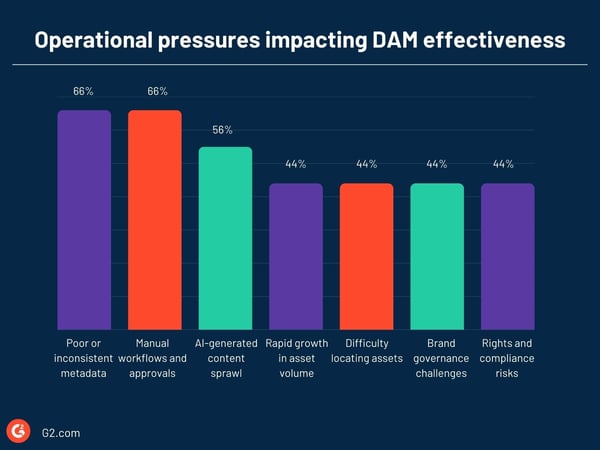
8 out of 10 vendors identified asset growth and AI-generated content volume as major operational pressures impacting DAM.
Platforms such as Stockpress, ImageKit, Bynder, and Papirfly described increasing ingestion rates tied directly to generative workflows. Organizations are producing more variations per campaign, more localized versions per asset, and more experimental creative outputs than ever before.
This growth is not limited to marketing teams. Product, ecommerce, and regional teams are also generating and modifying assets continuously. The result is a compounding expansion of asset libraries that traditional DAM governance frameworks struggle to manage efficiently.
IntelligenceBank highlighted that rising asset volume correlates with increased compliance and brand review demand. As more assets are published across channels and geographies, regulatory exposure expands.
Aprimo and Adobe Experience Manager also pointed to enterprise customers facing increasing governance complexity as generative content accelerates.
Scale is no longer episodic — it is permanent. DAM systems must adapt to operate within continuous growth environments.
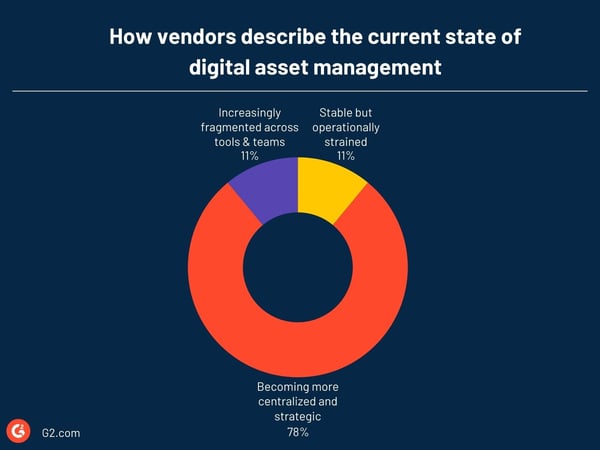
Across enterprise AI systems, the performance ceiling is determined by data quality. AI models can enrich, classify, and automate, but only when the underlying structure is reliable.
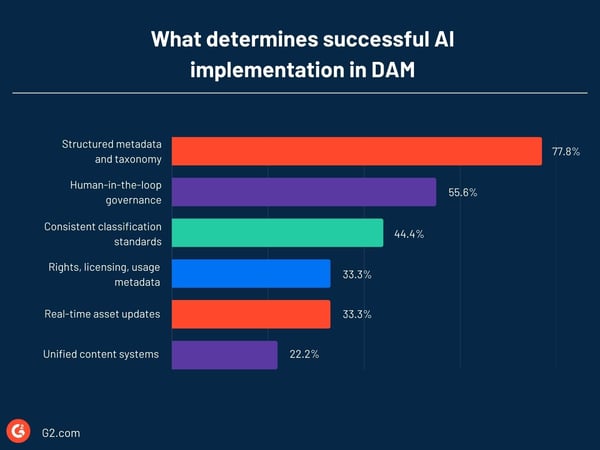
7 out of 10 respondents identified structured taxonomy and metadata consistency as the primary determinant of AI success.
Taxonomy as operational infrastructure
Kontainer emphasized the importance of well-defined classification systems before expanding automation. Without structured taxonomies, search relevance declines and governance enforcement becomes inconsistent.
Bynder similarly reinforced that discoverability improvements are directly tied to metadata accuracy and standardization across asset types.
Unified content architecture and rights metadata
Aprimo highlighted unified systems and rights metadata as foundational for dependable AI orchestration. When asset rights, expiration data, and usage permissions are structured, automation can safely enforce compliance policies.
Without these inputs, AI cannot reliably validate asset usage at scale.
Data hygiene before automation
4ALLPORTAL stressed prioritizing data quality before scaling AI-driven workflows. Expanding automation without structured metadata introduces operational risk rather than efficiency.
In DAM environments, AI performance is closely tied to how consistently metadata and governance rules are applied across assets.
Early AI features in DAM focused on tagging and search optimization. While foundational, competitive differentiation is shifting toward workflow intelligence and automation that reduces manual friction.
AI is no longer limited to describing assets; it is influencing how they move, get approved, and get activated.
Platforms including 4ALLPORTAL, Aprimo, Papirfly, and IntelligenceBank described AI embedded in approval routing and asset lifecycle workflows. Automation now supports enrichment, routing, and validation steps that previously required manual oversight.
This reduces bottlenecks and shortens campaign launch timelines.
“DAM solutions save time and costs, and AI further frees teams from repetitive tasks so they can focus on creative, high‑value work."
Daniel LückeDirector Software Solutions, 4ALLPORTAL
ImageKit discussed AI-powered validation at the ingestion stage, identifying incomplete metadata, incorrect formats, or quality inconsistencies before assets are distributed across systems.
This early-stage validation reduces downstream friction and governance errors.
Bynder and Stockpress emphasized enhanced contextual and semantic search, allowing users to retrieve assets based on intent rather than exact keywords. Improved discoverability increases asset reuse rates and reduces duplicate creation.
AI in DAM is moving from descriptive assistance to operational orchestration.
“In the AI era, the DAM that wins won’t just store content. It will understand it, adapt it, display it, and help teams distribute it intelligently."
Michelle BrammerDirector of Growth Marketing, Lingo
As synthetic and human-created assets coexist, organizations must manage authenticity, ownership, licensing, and compliance more rigorously than ever. Here, governance must be continuous.
6 out of 10 vendors highlighted governance-related challenges tied to AI-generated assets.
“Customer demand is driving widespread adoption of AI-assisted legal and brand marketing compliance reviews within DAM across advertising, web copy, and PDFs. Content creation is up 85%, and AI risk reviews are up 32% and rising fast. Video compliance is the next horizon."
William TyreeCMO, IntelligenceBank.
Bynder and Aprimo highlighted the increasing complexity of tracking ownership and asset lineage in AI-assisted environments. As assets are modified, localized, or regenerated, version control and usage rights must be clearly enforced.
Failure to track these elements introduces legal and reputational risk.
IntelligenceBank described increasing adoption of AI-assisted legal and brand review workflows. Automated pre-checks are being embedded earlier in content production to reduce compliance bottlenecks.
These systems enable organizations to scale output without proportionally increasing manual review teams.
Adobe Experience Manager pointed to emerging provenance and authenticity standards that require organizations to verify content origin and integrity.
As authenticity tracking becomes more relevant, DAM systems must incorporate structured validation processes.
Governance is no longer a downstream checkpoint. It is embedded directly within asset lifecycles.
“The future of DAM is agentic: always-on, policy-aware agents that orchestrate content operations end-to-end across tools and teams. As AI reshapes creation and activation, DAM leadership will be defined by runtime governance so every asset, transformation, and decision is fast, compliant, and traceable."
Kevin SouersChief Product Officer, Aprimo
Enterprise buyers increasingly expect measurable returns from AI investments. In DAM, ROI must be reflected in efficiency gains, reuse rates, and risk mitigation.
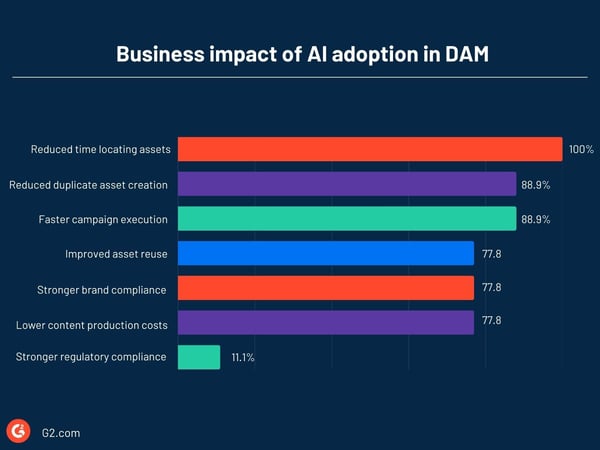
Vendors reported improvements in:
Aprimo and 4ALLPORTAL described measurable time savings tied to workflow automation and enrichment processes. Reduced manual routing and tagging allow teams to focus on higher-value tasks.
Bynder and Stockpress emphasized that improved search precision increases asset reuse rates, lowering production costs.
IntelligenceBank highlighted reduced manual review burden through AI-assisted validation.
However, respondents consistently indicated that AI delivers the strongest returns in environments where workflows, governance, and content standards are already mature.
As content volumes surge and generative AI accelerates asset creation, many organizations are discovering that adopting AI in digital asset management is not simply a technology challenge. It is increasingly a governance and operational maturity challenge.
Survey responses indicate that 6 out of 10 vendors cite trust gaps, integration limitations, or resistance to automation as primary barriers to scaling AI-driven DAM capabilities.
“Digital Asset Management is a prime example of where AI can be incredibly powerful, providing the tools that are adopted are useful rather than aspirational. Most DAM platforms are overly complex and expensive, especially in relation to what marketing, creative, and content teams in mid-market companies need to work well together."
Ian ParkesCRO, Stockpress
Bynder noted hesitation among some organizations to fully automate compliance workflows without human review layers.
Gradual adoption strategies and human-in-the-loop models are helping address these concerns.
4ALLPORTAL and Aprimo referenced integration complexity across CMS, PIM, and creative systems. Without seamless interoperability, AI orchestration potential is limited.
Several participants indicated that internal AI governance expertise remains a limiting factor. Successful adoption requires structured change management and operational clarity.
Technology readiness must be matched by organizational readiness.
“In the AI era, brand integrity becomes both more fragile and more valuable. AI can scale content creation exponentially, but without governance, it also scales inconsistency and risk. The organizations that win will be those that build the strongest brand equity while moving at machine speed."
Frank Tommy BrotkeHead of Product Marketing, Papirfly
Patterns and survey benchmarks provide directional insight. But the clearest way to understand how AI in digital asset management reshapes operations is to look at how it performs in real organizational environments.
Across contributing platforms, the most effective implementations share one common trait: AI is not treated as a passive enhancement layer. It is embedded directly into governance, workflow orchestration, enrichment, and execution — reducing friction between asset creation and activation.
The following case studies illustrate how that shift plays out across global brands, distributed enterprises, and creative organizations.
Kimberly-Clark modernized its digital asset management environment by replacing fragmented DAM and PIM tools, along with email- and spreadsheet-based workflows, with a unified content operations hub powered by Aprimo. By centralizing planning, creation, review, governance, and publication, the organization introduced structured metadata and AI-supported automation across its content lifecycle. This shift enabled teams to manage assets more consistently, streamline approval processes, and improve collaboration across brands and regions. The example illustrates how DAM modernization can help organizations bring content operations, governance, and automation into a single system as content volumes and distribution channels expand.
Woods MarCom, a marketing strategy and digital agency supporting multiple brands and campaigns, implemented Stockpress to consolidate its growing library of creative assets into a centralized digital asset management environment. Prior to adoption, assets were distributed across multiple systems, leading to inconsistent tagging, duplication, and time-consuming search processes. By introducing a unified DAM hub with structured organization and AI-enhanced search capabilities, teams gained faster access to relevant assets while maintaining brand consistency across campaigns. The result was improved collaboration, reduced duplication of creative work, and more efficient asset discovery — demonstrating how intelligent asset organization can improve productivity without increasing operational overhead.
– Read the full case study
TEEKANNE GmbH & Co. KG centralized its digital asset management processes by replacing decentralized SharePoint folders and email-based coordination with 4ALLPORTAL’s DAM platform. The implementation introduced a centralized, role-based asset hub supported by custom metadata structures and access controls, enabling teams across locations to locate and manage assets more efficiently. Integration with GS1 systems further streamlined product data distribution to retail partners, linking asset management with downstream product information workflows. As a result, the organization reduced duplication, improved transparency across departments, and strengthened collaboration, highlighting the operational benefits of structured DAM systems in distributed enterprise environments.
– Read the full case study
Note: These examples are drawn from publicly available case studies shared by participating platforms and are referenced here to illustrate how AI-powered digital asset management is implemented in real-world content workflows.
Across enterprise software, AI is evolving from feature enhancement to architectural foundation. The next generation of platforms will not simply include AI; they will be designed around it.
“DAMs will change from being just asset repositories with tags and metadata, to automated orchestration platforms with a brain of their own that will span across the entire content lifecycle - from creation to QC to final distribution. This change in DAMs will help businesses keep up with the large amount of content to be produced and consumed in the future."
Rahul NanwaniCEO, ImageKit
From system of record to system of action: Aprimo described a transition toward AI agents coordinating enrichment, compliance validation, and activation across systems.
Embedded and ambient DAM: Adobe Experience Manager outlined DAM capabilities delivered through embedded assistants within other enterprise applications.
“The future DAM isn’t just a system of record — it’s the intelligent content advisor powering experiences everywhere. AI is transforming DAM from a destination application into distributed, real-time intelligence embedded across the content ecosystem, with discovery, metadata, governance, and rights validation happening through AI assistants inside everyday tools."
Marc AngelinovichDirector of Product Marketing and Strategy, Adobe Experience Manager.
DAM–PIM convergence: 4ALLPORTAL emphasized increasing integration between DAM and product information systems to unify content and product workflows.
Multimodal and agentic expansion: ImageKit referenced multimodal AI models and cross-application agents as emerging differentiators.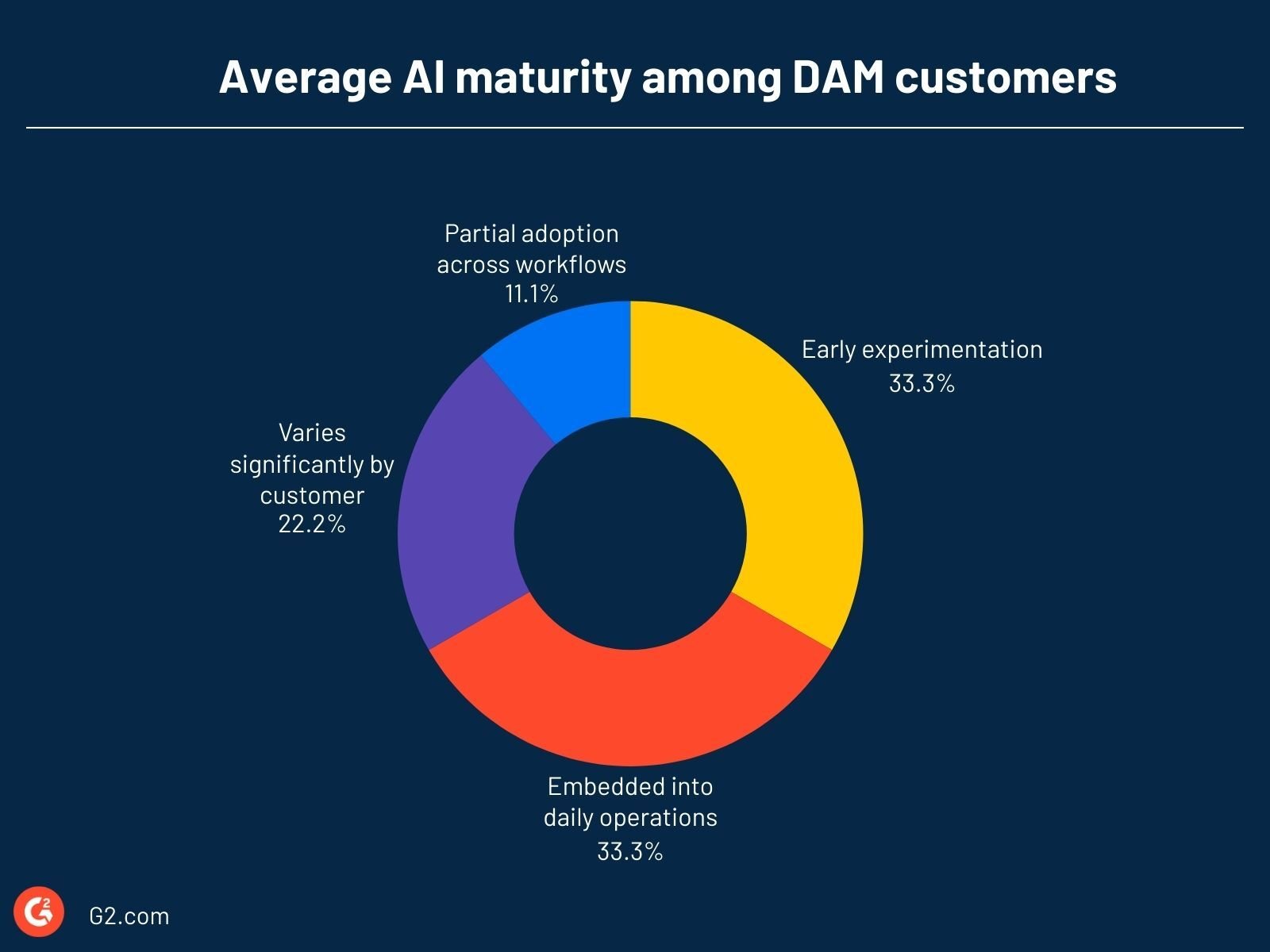
"AI is transforming digital asset management into an intelligent and strategic platform for governance, discovery, and scale. This report highlights how teams are using AI to automate metadata, enable semantic search, and drive greater efficiency across global content workflows. The next generation of DAM will be defined by how effectively organizations use AI to connect content, teams, and workflows across the business, all with human oversight as key."
Bob HickeyCEO, Bynder
One thing these insights make clear is that DAM is becoming a core layer of enterprise governance infrastructure. The winners won’t be the fastest adopters of AI features; they’ll be the organizations that build structured foundations and scale content with control. Here’s what one should look at as priorities:
The transformation underway in digital asset management is not about incremental feature enhancement.
It is about governance at scale.
In this environment, DAM increasingly becomes:
The next 24–36 months will create a visible divide. Organizations that approach AI in DAM as a tactical feature rollout will see incremental efficiency gains. Organizations that treat DAM as a governance infrastructure will unlock a durable competitive advantage.
Explore G2’s Governance, Risk & Compliance solutions to see how organizations are strengthening oversight, compliance, and governance in AI-driven content operations.


Do you trust AI? Not just to autocomplete your sentence, but to make decisions that affect...
 by Soundarya Jayaraman
Is AI in data integration actually reducing headcount — or just shifting the work?
 by Seba Koshy
Artificial intelligence has entered customer support with a force that few operational teams...
by Seba Koshy