


AI content creation software has moved from experimental to essential, but the gap between vendor claims and real-world outcomes remains significant. And while AI content creation software certainly provides buyers with great benefits, there are still a few myths in need of scrutiny.
Key proven benefits of AI content creation software include its ability to dramatically improve the speed and scale of content creation processes. However, these tools do not provide a fully autonomous content creation process. Instead, it enhances creative workflows, rather than replacing them. Its greatest value and ROI come when paired with real human skill, particularly oversight and thoughtful brand strategy.
AI content is fast, but not flawless. 37% of buyers cite speed as a top benefit, while 36% say quality still falls short of “publish-ready.”
Several myths that permeate the space include AI content creation tools’ alleged ability to fully replace marketers, writers, or designers. It’s the thought that the perfect AI content creation tool can flawlessly handle every content format and use case, and this type of software’s ability to provide outputs is immediately production-ready without proofreading or editing.
G2 Data and buyer experiences support the stated benefits of these tools. The myths stem from a fundamental misunderstanding of how AI, especially in creative fields, can assist people instead of replacing them entirely. The reality, however, sits in the middle of these disparate points: Content creation platforms with AI capabilities are powerful accelerators, not complete replacements for human creativity or judgment.
Buyers, evaluating AI content creation tools, are often navigating an overwhelming volume of vendor messaging, much of which emphasizes transformative, all-in-one capabilities. This report addresses a central buyer challenge: separating what vendors promise from what users actually experience in practice.
.png?width=600&height=600&name=ai-content-creation-platforms-by-review-count%20(1).png)
Across leading products in this category, including platforms like Canva, Jasper, Creatify AI, Conductor, and Amplience, vendor positioning tends to converge around recurring themes. Many vendors present their solutions as end-to-end creative platforms capable of handling the full content lifecycle, from ideation through to publication. The promise is a unified system where blog posts, social media content, visuals, and even video assets can all be generated within a single workflow, eliminating the need for multiple tools.
Another common claim centers on speed and quality, which prospective buyers often interpret as "instant, publish-ready” content. Vendors frequently assert that their platforms can generate high-quality, publish-ready content almost instantly, dramatically reducing production timelines. Closely tied to this is an emphasis on brand consistency, particularly for enterprise buyers. Platforms claim to learn and replicate brand voice across channels, ensuring that messaging remains cohesive even as content volume increases.
“We’ve seen AI help our users create content up to 79% faster, which directly impacts how quickly teams can move from idea to execution. Faster creation leads to quicker internal approvals, shorter production cycles, and the ability to publish timely content — striking the iron while it's hot.”
Chelse Hensley
”
Social Media Manager, Visme
AI content creation software vendors also make bold claims related to massive productivity gains; while the previous claim focuses on production time, this claim is related to production volume. Vendors making this claim highlight their products’ abilities to scale output and reduce costs while also still emphasizing a (nearly) flawlessly accelerated campaign execution. Many position their tools as intelligent systems capable of optimizing performance automatically.
This means that AI content creation software vendors are branding their products as capable not only of creating content quickly, efficiently, and effectively, but also through the end of the publication lifecycle with SEO optimizations, engagement insights, or continuous learning from data for further use beyond hitting “Publish.”
The idea that AI can independently produce strategic, creative, and high-quality content without human involvement remains one of the most pervasive myths in the category, and G2 data partially validates it.
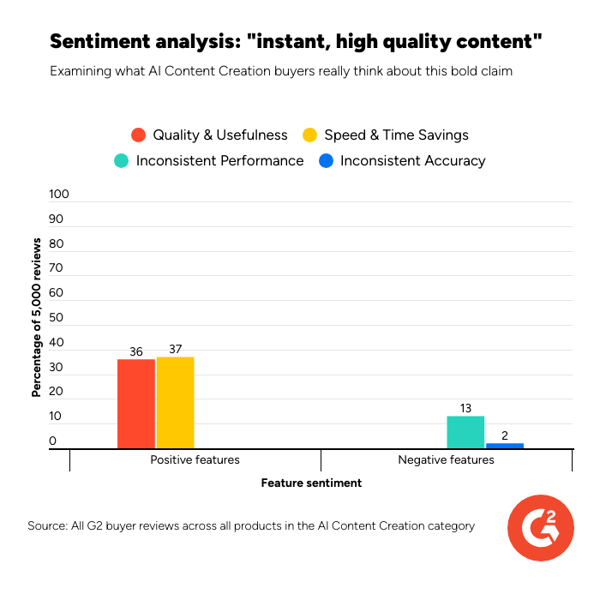
In reality, AI excels at generating drafts, repurposing existing material, and producing variations at scale. For example, while 36% of AI content creation platform buyers praise this category of software’s quality and usefulness, 13% of buyers readily admit that these powerful tools still face issues with inconsistent performance and outputs. While these capabilities significantly accelerate content workflows and reduce manual effort, they definitely require oversight and review.
“The best solutions allow organizations to operationalize their brand — embedding voice, tone, and guidelines directly into the AI — while continuously aligning content to what’s working in search and across channels,”
Lindsay Boyajian Hagan
VP of Marketing, Conductor
The technology also falls short in areas that require deeper understanding and originality. Human ingenuity is still required for progenation and oversight when working with AI content creation tools. Specifically, strategic thinking, nuanced brand storytelling, and emotionally resonant messaging remain firmly human strengths at present. Human-in-the-loop activities are necessary for oversight, editing, and direction to ensure quality and alignment with pre-defined business goals. In practice, AI shifts human contributors into more strategic roles rather than eliminating their involvement altogether.
“It often struggles with authentic storytelling and emotional resonance. AI can generate perfectly formatted bullet points and slide layouts, but it can sometimes lack the unique brand voice, real-world anecdotes, and human nuance that truly connect with an audience during a live pitch or presentation”
Paulos Raja
CSO at Slideegg
The idea that a single AI content creation platform can deliver best-in-class output across every content format is one of the most common assumptions in this category. This simply isn’t true, though, and the market remains highly specialized. Different platforms have emerged as leaders in specific areas rather than across the board. Canva, for example, is widely recognized for its strength in visual content and template-driven design workflows, while Jasper has established itself as a leader in AI writing and brand voice management. Platforms like Creatify AI and AKOOL are more focused on video generation and advertising use cases.
In reality, according to half of G2 customer survey respondents, half reported that it was difficult to quantify time savings or that such data isn’t tracked or measurable at present. The half that could quantify time saved per page of content reported an average 10–20% increase at minimum.
Although multimodal platforms are becoming more common, their capabilities are not yet evenly distributed. This means buyers will need to carefully examine which AI content creation tools can meet their predetermined needs. Additionally, the quality of output often varies depending on the format, and depth in one area can come at the expense of performance in another. As a result, buyers frequently find that relying on a single platform does not fully meet their needs. Instead, most organizations adopt a combination of complementary tools to achieve the best overall results.
AI content creation software is best understood not as a replacement for human creativity, but as a force multiplier whose real value emerges when integrated into workflows that prioritize usability, governance, and specialization over the illusion of all-in-one automation.
At its core, AI functions as a force multiplier. It enhances productivity, efficiency, and scalability, enabling teams to produce more content without proportionally increasing resources. However, it does not replace creativity, strategic thinking, or human judgment.
“Highly nuanced editorial, emotional, or culturally sensitive storytelling where tone and context require deep human judgement, can be where these platforms struggle. AI-generated content also performs best when source data is rich and structured. Where product data is incomplete or inconsistent, output quality suffers and engagement gains are harder to realise.”
Jennie Grant
Content Marketing Specialist, Amplience
Other survey respondents echoed this sentiment.
“Viewers no longer just discount content because AI was used to create that content. However, when there are no new insights used over AI generated content structures, it struggles to drive engagement. ”
Sanket Shah
Founder and CEO, Invideo.io
Organizations that see the greatest success are those that integrate AI into their workflows rather than attempting to replace those workflows entirely.
The category itself is also evolving rapidly. What began as a collection of point solutions is becoming a broader ecosystem of integrated platforms that support collaboration, governance, and end-to-end content operations. Buyers are increasingly prioritizing systems that fit into their workflows rather than standalone tools that operate in isolation.
Differentiation is also shifting. While early competition focused heavily on generation quality, the current landscape emphasizes usability, workflow integration, and brand consistency. Platforms that enable teams to create, manage, and scale content effectively are emerging as leaders.
At the same time, enterprise considerations are becoming more prominent. As adoption grows, particularly among larger organizations, requirements around data privacy, compliance, and brand control are shaping purchasing decisions. AI capability alone is no longer sufficient; governance and reliability are equally important.
Finally, while multimodal content creation represents the future of the category, it remains an area in development. Unified platforms are improving, but specialized tools often still outperform general-purpose solutions in specific domains. Consolidation may occur over time, but it has not yet fully materialized.
For buyers, the gap between perception and reality has direct implications for how these tools should be evaluated and implemented. A more grounded and strategic approach is essential.
When buyers consider their options within the category of AI content creation software, they ought to first internally determine what type of software they’re seeking to have AI produce for them. Remaining clear-eyed when speaking with multiple vendors to determine which specific product aligns with their own organization’s AI content creation strategy will yield the best outcome.
Check out the Hype vs. Reality of AI Content Creation tools and learn from other buyers what certain products’ strengths and weaknesses are.


Managing a growing pile of images, videos, documents, and other digital content can quickly...
 by Soundarya Jayaraman

Why trust G2 on AI G2 doesn't just index AI tools. We use AI to power our own platform, and...
 by Harshita Tewari
I no longer treat AI content creation platforms as new or experimental, and most teams I work...
 by Washija Kazim