G2 Insight Report Q1 FY27 pattern

The Answer Economy:
How AI Search is Rewiring
B2B Software Buying.

Introduction

Over the last few centuries, there have been three major compressions in the buying journey. First, The Yellow Pages collapsed the market into a single book. Then Larry Page's PageRank compressed that book into a single page of results. Now, we're watching the third era of compression unfold in real time. You don't buy the biggest ad or earn the top spot on Google — you win the answer.

What's changed isn't just where buyers start, it's what they're doing throughout the entire journey. They've moved from reference to inference. Instead of weeks of research, they're using ChatGPT to one-shot their shortlists. Today, 51% start their research with an AI chatbot more often than Google, and 71% rely on AI chatbots somewhere in the software research process. The starting point hasn't just shifted. It's split.

G2 has been tracking how software buyers research, evaluate, and choose software for over a decade. This moment feels different because AI chatbots are compressing the research process so dramatically that vendors who don't show up in the first answer are squeezed out before the conversation even starts. We’ve moved past AI as an intelligence layer and are staring squarely at AI as a trust layer.

This report was created to understand exactly what that shift means for software vendors. We polled over 1,000 B2B software buyers and decision-makers and learned that while 93% say AI chatbots have fundamentally changed how they conduct research, AI is not replacing the buying process. Instead, it’s redirecting it in ways that have very specific implications for which vendors get found, trusted, and ultimately, selected.


Tim Sanders, Chief Innovation Officer at G2
Tim Sanders
Chief Innovation Officer
introduction
Key Findings
01
The buyer journey has forked.
B2B software research increasingly begins in a chat window. Buyers haven’t stopped Googling, but 71% say they now rely on AI chatbots for software research, up from roughly 60% just 7 months ago. More importantly, half (51%) now start their software research with an AI chatbot more often than Google.
02
AI is shaping which vendors win.
In the answer economy, buyers have moved from reference to inference — not asking AI chatbots to point them toward sources, but telling AI to synthesize everything and return a shortlist. Buyers say AI chatbots are the #1 source influencing their shortlist, and 8 out of 10 say those AI chatbots accelerated their purchasing decision. 69% report that AI chatbots have surfaced information that led them to choose a different vendor than expected.
03
Review sites are the trust layer in AI search.
Buyers trust recommendations from AI chatbots, but they still want receipts. Trust is increasingly embedded in the answers AI provides, and reviews are its most confidence-inspiring signal. When an answer gives buyers pause, they often seek out peer feedback from communities like G2 and Reddit to verify. For vendors, winning the answer depends on winning the trust layer.
04
Buyers aren't experimenting anymore.
Nearly two-thirds of buyers now spend 6+ hours per week using AI chatbots for work, and over 40% self-identify as power users leveraging them daily. Between the adoption of deeper workflows (for example, Deep Research), frequent use of “thinking” modes, and commercial-intent prompts (category comparisons, alternatives, requirements), today’s buyer is using AI search to do serious evaluation.
01

The buyer journey has forked.

The buyer journey has split into two distinct starting points: traditional search and AI search. More than half of B2B software buyers now say they start their research with an AI chatbot more often than Google. That means the first impression of your brand, category, and competitors is increasingly formed inside an AI answer, before a buyer visits a vendor's website or speaks to their team.

We're no longer watching a trend take shape. AI chat is now a mainstream research motion that B2B software buyers actively use to get oriented, compare options, and narrow the field.

The B2B software funnel increasingly starts with a chat prompt, not a Google search.

 
51%
of B2B software buyers start their research with an AI chatbot more often than Google.

AI chatbots have earned a seat in every stage of the funnel. Buyers haven't abandoned traditional search — 80% still use Google somewhere in their buying journey — but they increasingly see it as a complementary function rather than an essential one. Asking a chatbot for answers is now the first move for half of buyers.

That means the first impression of your brand, category, and competitors is often formed inside an AI answer, before a buyer visits a vendor's site or speaks to Sales.

This is a behavioral shift that has reached a tipping point much faster than most vendors expected. As AI search capabilities improve, expect more buyers to become AI-first in their research motion.

What this means for vendors:

  • Visibility in AI search depends on winning the answer, not winning the click.
  • AI discoverability needs to be a core go-to-market (GTM) motion because buyers are forming shortlists quickly.

AI search is now a one-way door to productivity.

"I'm more productive with AI search than traditional search engines."

36%
53%
AUG 2025 FEB 2026

AI didn't just give buyers a new starting point — it drastically improved their outcome. 53% say their software research is more productive with AI search than with traditional search. That number is up sharply from 36% just 7 months ago.

The gains are real. Buyers who once needed weeks to compare vendors can now use their favorite AI chatbot to get a usable synthesis in minutes. And, they don't just start with a prompt. They leverage chat to run comparisons, and ultimately, to decide.

That type of productivity gain is sticky, and it's why usage keeps growing. 86% of B2B buyers increased their use of AI chatbots for software research in the past year.

What this means for vendors:
  • There's no waiting this out. Buyers are actively using AI chatbots to evaluate you, your competitors, and your category and build their vendor shortlist — and their usage is only increasing.
  • AI search has become a full-funnel channel, where buyers are now forming opinions and building evaluation shortlists before your sales team even knows they exist.

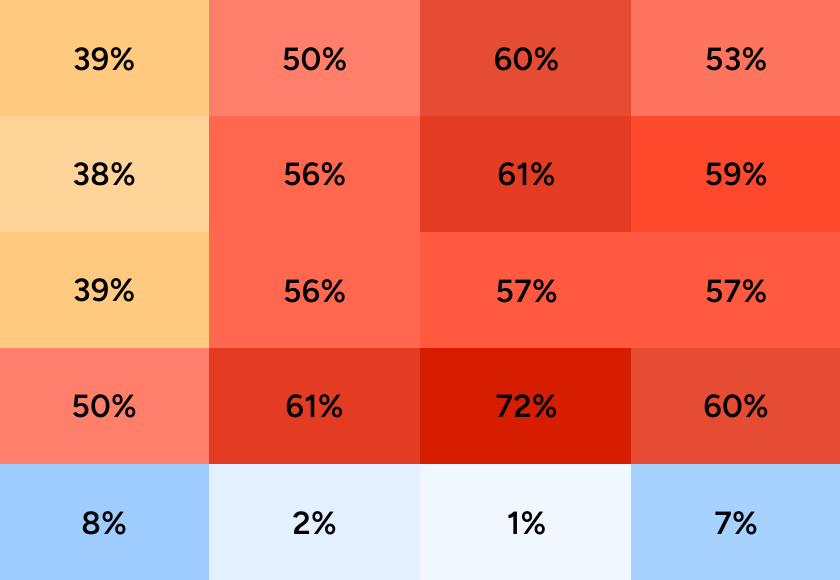
How has the rise of AI search impacted your software research process?

Start research with AI search more often than Google
More productive with AI search than traditional search
Use AI search to summarize reports or whitepapers
Use AI search alongside Google during discovery
AI search has not significantly changed my research habits
Heatmap showing AI Search impact across SMB, Mid Market, Enterprise, and Large Enterprise segments
SMB
Mid Market
Enterprise
Large Enterprise
The best marketing teams we work with aren't asleep. They're just measuring what they've always measured — page rankings, domain authority, click-through rates, etc. The problem is buyer behavior has moved faster than their instrumentation. Buyers are researching in AI now, and most brands have limited visibility into how they show up in those conversations. Even the ones who do have visibility rarely have the tooling to act on it as fast as they'd like.
Trevor Pyle, Head of Marketing at Profound
Trevor Pyle
Head of Marketing, Profound
02

AI is shaping which vendors win.

This is the Answer Economy. If AI chatbots don't name you in their recommendations, you’re not even in the running. Nearly 7 in 10 B2B software buyers chose a different software vendor than expected in their last buying cycle because of guidance from an AI chatbot. Winning the citation isn’t enough anymore — software vendors need to win the answer.

AI chatbots are the #1 source influencing which vendors make buyer shortlists.

Gen AI Chatbots
54%
Software Review Sites
43%
Market Research Firms
36%
Vendor Site
36%
Peers & Colleagues
33%
Independent Forums
30%
Thought Leadership
28%
Internal Supplier Portal
20%
Vendor Salesperson
19%
None of the Above
1%

Simply being mentioned by AI chatbots carries weight for today’s software buyer, as 85% think more highly of a vendor cited by AI in its answer. 

It’s not just perception, though — AI chatbots are curating shortlists and impacting purchasing decisions. 69% of software buyers we polled said that an AI chatbot led them to select a different software vendor than initially planned. 33% purchased from a vendor they'd never previously heard of before.

The same mechanism that lifts an unknown vendor into contention can also exclude a well-known category leader. That is a glaring case to strengthen answer engine optimization (AEO) strategies immediately.

What this means for vendors:

  • If your brand isn’t structured as a "source of truth" for AI chatbots, you aren't even in the consideration set.
  • Winning the citation isn’t enough — you have to win the answer.
  • AI can't summarize what it can't find. Vague positioning means no representation.

A buyer's first prompt comes with commercial intent.

Which of the following best describes your initial type of AI prompt when researching software?

Category-based
33%
Competitor-based
31%
Requirements/Process-based
22%
Ecosystem-based
9%
Budget-based
6%

Buyers who use AI chatbots to research software aren't easing into it. They lead with commercial intent from the very first prompt.

Two-thirds start with category or competitor queries. These are evaluation prompts designed to return a list of best-of-breed vendors buyers can easily evaluate. Only one in five start with questions about requirements or process.

And the process moves fast. Four out of five buyers told us AI chatbots helped accelerate their purchasing decision, and 83% said they felt more confident in their final choice.

What this means for vendors:

  • The software buying cycle is compressing at the top of the funnel because AI chatbots have already done the heavy lifting for buyers.
  • Buyers are naming your competitors in their first prompt. Vendors who invest in AEO now will have a structural advantage over those who don’t optimize for AI search.
  • Winning the sources that AI chatbots cite for category and competitor comparisons is crucial for discovery.

8/10 buyers say AI chatbots accelerated their purchasing decision.

When using AI chatbots for software research, how has AI affected the speed of your purchasing decisions?

Much faster
37%
Somewhat faster
46%
No change
14%
Somewhat slower
2%
Much slower
1%

AI chatbots changed the outcome for 2/3 software buyers.

During your most recent software eval, did an AI chatbot influence the software vendor you ultimately selected?

Yes — chose a vendor I hadn’t considered
33%
Yes — chose a vendor I was familiar with
36%
Yes — it reinforced the vendor I expected
22%
No — it didn’t influence my decision
7%
Haven't selected a vendor yet
1%
AI chatbot wasn't used
1%
Buyers used to spend hours, if not days, cobbling together a spreadsheet and rounds of research, looking for trust signals to winnow down their list to three or four. Now, they one-shot it with an AI chatbot prompt that returns a consideration set before they've visited a single vendor website. They’ve outsourced both the primary research and the synthesis to recommendation engines. Vendors need to stop thinking about AI chatbots as a search channel and start treating them as the new shortlist generator.
Tim Sanders, Chief Innovation Officer at G2
Tim Sanders
Chief Innovation Officer
03

Review sites are the trust layer for AI search.

In the answer economy, trust is the new currency. AI chatbots need verified signals to distinguish from noise, and buyers expect proof that the answers returned by the chatbot are sourced from real human experiences. Both look to software review sites to check their work before taking their next action.
Buyers look for review site citations when deciding whether to trust AI search results.

 
45%
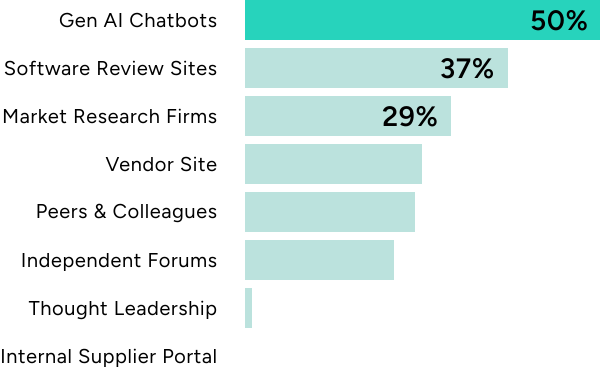
of B2B software buyers say review site citations are the most confidence-inspiring signal in an AI answer.
Bar chart showing review citations inspire the most confidence among AI power users

Software buyers trust AI chatbots, but they still want receipts. 

When we asked buyers what would increase their confidence in an AI chatbot’s answer, the #1 response was a citation from a review site. That matters because review platforms feed the large language models (LLM) that generate the responses buyers are looking for.

AI chatbots run on peer reviews, and review sites are the #2 source influencing buyer shortlists. Customer voice across review sites like G2 shapes how a chatbot perceives your brand, and what it ultimately returns to buyers. 

This effect is strongest among the most experienced AI chatbot users. Self-identified Power users leveraging chatbots daily cite review sites as their #1 confidence signal at an even higher rate (50%) than the general B2B software buyer population. The most AI-fluent buyers show the strongest relative preference for review citations over every other source.

What this means for vendors:
  • Reviews are core AEO infrastructure. They shape what AI chatbots say about you.
  • A thin review presence means AI chatbots have less to work with. That means a weaker answer, or even no mention at all.

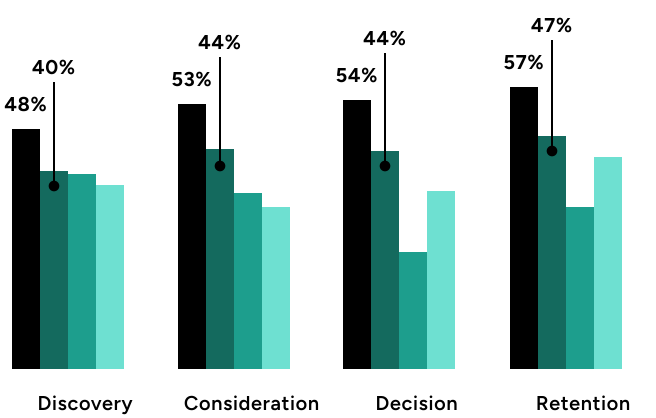
Review sites remain a critical trust signal throughout the buyer journey, along with AI chatbots.

Grouped bar chart showing source influence across Discovery, Consideration, Decision, and Retention funnel stages
 GenAI chatbots
 Review sites
 Peers & colleagues
 Vendor sites
 Market research firms

Review sites are the only source besides AI chatbots that gains influence deeper into the funnel.

Review sites aren't just shaping which vendors get discovered — they're contributing to which vendors get chosen. This reinforces why they work as a system. AI chatbots build the shortlist, review sites validate it, and buyers put increasing confidence in both sources as the stakes get higher.

What this means for vendors:
  • A review strategy isn't just a top-of-funnel play. Buyers lean on peer reviews more heavily at the decision stage than they do at discovery.
  • A weak review presence costs you the most in the decision and retention stages.
  • Reviews are the one source that feeds AI chatbots and follows the buyer all the way through their journey.

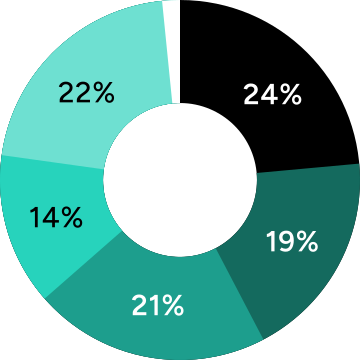
When AI makes a mistake at the brand level, peer reviews are a buyer's gut-check.

Donut chart showing buyer responses when AI makes a brand-level mistake: Look for peer feedback 24%, Ask AI why omitted 22%, Prioritize AI-recommended 21%, Try another AI tool 19%, Default to familiar brand 14%
 Look for peer feedback to vet recommendation — 24%
 Try another AI tool / prompt to see if the results match — 19%
 Prioritize the AI-recommended option — 21%
 Default to the brand I am familiar with — 14%
 Ask the AI why the brand was omitted — 22%

AI chatbots get it wrong more often than people realize. In fact, 64% of buyers say they encounter inaccuracies often (a few times per month) or very often (weekly or more). But the pace it enables is too valuable to give up. So, they verify. 

When AI chatbots leave out a brand they trust, or get something wrong about one they know, most buyers seek out peer reviews for a second opinion.

Buyers also perceive cross-chatbot consistency as a top trust signal. If ChatGPT, Gemini, and Claude all describe a vendor the same way, that builds confidence, even though the mechanism behind that motion is not something vendors can directly engineer. Inconsistencies represent a red flag to buyers, and they'll dig deeper to find out which version is true.

What this means for vendors:

  • Accounting for AI hallucinations is key to future success. AEO is not just about discoverability — it's also a hedge against accidental misrepresentation by AI chatbots.
  • When AI chatbots provide unexpected recommendations, a buyer's next move is peer reviews. So, a strong review presence is your safety net.
Review sites are most effective at the bottom of the funnel. When software buyers reach the evaluation stage of their journey, the recommendations they see from AI increasingly stem from trusted peer proof sourced from platforms like G2. With G2’s now significant influence on LLM citations and AI search visibility, there is a strong case for vendors to maintain a steady presence across the G2 ecosystem.
Kevin Indig, Growth Advisor
Kevin Indig
Growth Advisor
04

Buyers aren't experimenting anymore.

Nearly two-thirds spend 6+ hours a week leveraging AI chatbots for work — notably higher than 7 months ago — and more than 40% self-identify as daily power users. They're running head-to-head vendor comparisons, creating Deep Research reports, and using Thinking mode for high-stakes evaluations.

Buyers are using AI chatbots for product evaluation, not just discovery

Primary use cases for AI when researching software.

01
Comparing strengths & weakness across vendors
02
Learning basic information about the category
03
Initial identification of vendors worth considering
04
Validating specific use cases
05
Validating an initial recommendation
06
Narrowing options to a shortlist
07
Drafting RFP questions based on business need
08
Understanding pricing/packaging options

Buyers aren't asking AI chatbots to orient them in a new category. They already know what they're looking for. Comparing vendor strengths and weaknesses is the #1 reason for using AI chatbots in software research, ahead of basic product research, vendor identification, and use case validation.

This clearly illustrates how and where chatbots are gaining ground in software buying. While it’s collapsing the top-of-funnel discovery stage, it’s also extending deeper middle and bottom of the funnel actions. Buyers are using AI chatbots to draft requests for proposals (RFP), work through pricing and packaging options. and validate fit.

What this means for vendors:
  • Buyers using AI chatbots for software research have a higher standard for content and proof. They expect clear documentation, crisp positioning, credible reviews, and third-party validation.
  • The best-supported, most consistently represented vendor in a category has a compounding advantage — AI chatbots will favor them in every comparison, and buyers will trust that info.
  • Sales teams should assume the buyer has already conducted research and even seen an AI-generated competitor comparison. The first conversation needs to go deeper than a standard pitch.

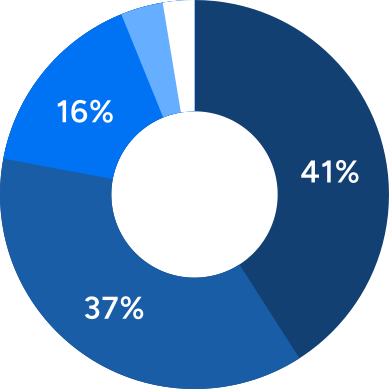
41% of buyers use Deep Research tools regularly when researching software. Just 2% have never heard of them.

Donut chart showing Deep Research adoption: Use regularly 41%, Use occasionally 37%, Standard prompts only 16%, Heard of but don't use 4%, Wasn't aware 2%
 Use regularly — 41%
 Use occasionally — 37%
 Standard prompts only — 16%
 Heard of but don't use — 4%
 Wasn't aware — 2%

When we examined the types of AI chat tools buyers were using to conduct software research, most buyers (44%) told us they default to “Thinking” or “Reasoning” models. They deliberately choose these slower, more thorough output options when the decision matters.

But, research tools like Deep Research are more popular than people realize. Just 6% of buyers said they don’t use Deep Research — which generates structured, multi-source evaluation reports in minutes. This high adoption further indicates that today’s buyer is running complex, multi-source evaluations with AI search.

When asked how it holds up next to standard models, nearly half of buyers said the output from Deep Research is meaningfully better. These are real evaluation workflows that now live inside a chatbot, rather than being shared by a handful of employees on the project team.

What this means for vendors:
  • Buyers are deliberately choosing the most thorough AI chatbots available. The level of scrutiny your brand faces inside AI is increasing as these tools mature.
  • The query is a long-form journey. You want to be at the end of that return, in the punch line where the model makes its recommendation.

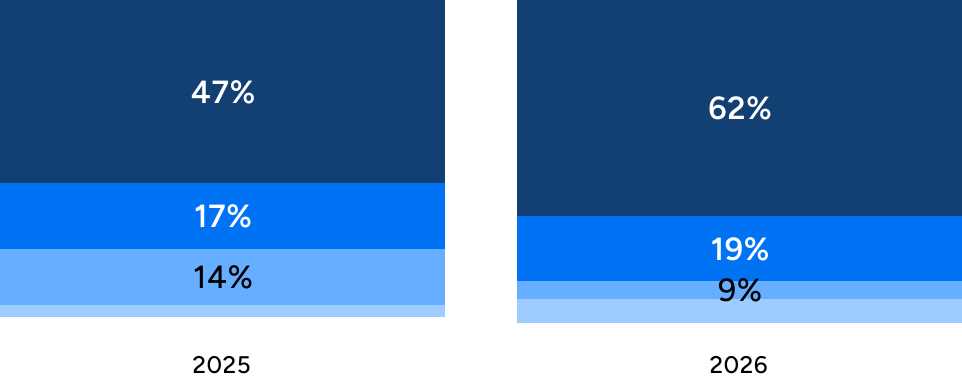
ChatGPT dominates, but the AI chatbot landscape is shifting fast.

Stacked bar chart showing chatbot market share: 2025 vs 2026. ChatGPT grows from 47% to 62%, while Gemini, Microsoft Copilot, Claude, and Perplexity shift positions
 ChatGPT
 Gemini
 Microsoft Copilot
 Claude
 Perplexity

ChatGPT is the most popular AI chatbot across every segment — but mid and bottom funnel chatbot usage is more competitive

73%
14%


Discovery
53%
22%


Consideration
56%
23%


Decision
57%
19%


Retention
 ChatGPT
 Gemini
 Copilot
 Claude
 Perplexity

ChatGPT is the dominant AI chatbot for work, and its usage is concentrated at the top of the funnel. But, the landscape is shifting fast — Claude more than doubled its share in the past seven months, while Copilot and Perplexity both declined sharply. Meanwhile, the race for second place is wide open. Gemini nearly doubles its share between discovery and consideration, and Copilot, Claude, and Perplexity all hold steady or gain ground as buyers move deeper into the funnel.

ChatGPT is the top AI chatbot across every segment — but secondary preferences vary by industry and company size.

ChatGPT 61% 65% 53% 57% 66% 54% 66%
Gemini 14% 14% 23% 28% 16% 24% 21%
Copilot 10% 7% 10% 8% 5% 11% 6%
Claude 8% 10% 10% 3% 6% 2% 6%
Perplexity 2% 2% 2% 2% 2% 5% 0%
None 3% 1% 0% 2% 1% 3% 0%
  Financial Services Healthcare Manufacturing Retail Technology Services Construction
ChatGPT 58% 62% 70% 57%
Gemini 21% 19% 14% 18%
Copilot 6% 8% 10% 13%
Claude 7% 7% 3% 6%
Perplexity 2% 1% 1% 3%
None 2% 1% 0% 2%
  SMB Mid Market Enterprise Large Enterprise

ChatGPT leads across every industry and company size, but the margins vary. In manufacturing, ChatGPT's lead shrinks to nearly 10 points below its average while Gemini picks up 23%. Construction shows a similar pattern. In enterprise and large enterprise environments, Copilot holds a 10–13% share, which may be driven by Microsoft's bundled distribution through Microsoft 365. Claude's strongest showing is in the small business (SMB) sector (7.3%), which tracks with its reputation among technical early adopters.

What this means for vendors:

  • There is no single AI answer about your brand. What ChatGPT says about you may not match what Gemini says, or what Copilot returns inside a buyer's Microsoft 365 environment.
  • Because chatbot preference correlates with industry and company size, different segments of your market are getting different versions of your story.

ChatGPT is the default at every level, but technical roles show more diverse chatbot usage.

ChatGPT 58% 61% 66%
Gemini 18% 18% 23%
Copilot 8% 9% 4%
Claude 8% 6% 3%
Perplexity 3% 2% 2%
  Individual Contributors Manager / Director / VP C-Suite
ChatGPT 64% 68% 62% 56% 62% 51% 49%
Gemini 16% 17% 18% 16% 23% 25% 29%
Copilot 9% 9% 9% 10% 7% 9% 10%
Claude 4% 4% 8% 9% 5% 12% 5%
Perplexity 2% 0% 2% 2% 0% 1% 0%
  Info Technology Senior Management Accounting / Finance Purchasing / Procurement Operations Engineering / R&D Service / Support
  • C-suite executives are the most ChatGPT-dominant group, but the role-level data tells us a few interesting stories.
  • Engineering/R&D shows the most diverse chatbot usage, including Claude reaching its highest share in any function.
  • This suggests that the more technical or evaluation-heavy the role, the more likely buyers are to use multiple tools.
  • For vendors, this means the person comparing you in ChatGPT may not be the same person running the Deep Research report in Claude — but both of their impressions matter.
While working with AI to aid the evaluation process, we usually include questions related to feature depth, scalability, pricing models, and performance, and we usually cross-check the answers provided by AI with other AI tools to ensure consistency.
Arkajit Dass, G2 Icon
Arkajit Dass
CTO at Fraoula & G2 ICON
Aqib Zargar, G2 Icon
Aqib Zargar
CRM Exec at Bajaj Allianz Life Insurance & G2 ICON
I typically ask AI to compare vendors side by side, break down pricing models, highlight pros and cons, and sometimes simulate use cases. I also cross check responses across multiple tools to avoid bias. What used to take days now takes a few hours, though I still validate key decisions manually.

What GTM leaders are already seeing

Using G2's AI Custom Research (AICR) solution, we conducted interviews with 39 B2B software marketers globally, exploring their experiences with the rise of AI-driven search and how they’re adapting to this shift.

01
Most marketers know AI discoverability matters, but most aren't ready.
Nearly every respondent called it a "must-have" for pipeline. Yet, the majority described themselves as early-stage or still figuring out their approach, with competing internal priorities slowing them down. Respondents reported measurable declines in organic search traffic — some significant — while LLM-sourced traffic ticked up. For many, seeing their own name missing from AI-generated results was the moment they took it seriously.
02
Reviews are showing up in AI-generated answers, and marketers are responding.
Several respondents independently observed AI chatbots pulling from review sites when generating vendor recommendations. In response, some are actively coaching customers to write more detailed, context-rich reviews — specifically noting what problems were solved and what alternatives were considered.
03
Prompt-testing has become a DIY competitive intelligence practice.
Across maturity levels, respondents described regularly typing buyer prompts into ChatGPT, Gemini, and Perplexity themselves to see whether they appear, who shows up instead, and using those gaps to guide their content priorities.
04
Attribution is the loudest, most consistent frustration.
Respondents at every stage described the same problem: They can see signals that AI chatbots are influencing pipeline, but they can't measure it cleanly. Many described it as investing in a channel they can't yet prove.
05
Adaptation is happening, but it's largely tactical and fragmented.
The most common tactics marketers told us they’ve embraced are content restructuring (FAQ format, answer-first writing, comparison pages) and increased review generation, but few described a fully integrated, scalable strategy.

What can vendors do to win the AI answer?

The vendors who win in the era of AI-powered search will be the ones who invest in the trust infrastructure that AI depends on. Here are three things you can do today.

01
Collect reviews at all stages of the buyer journey.
Look for ways to engage your customer/buyer community in an always-on fashion – requesting they submit reviews for your products through ongoing review campaigns, in-app review collection, and after any standard customer touchpoint.
02
Ensure your profiles feature the most accurate content and positioning.
Think beyond your owned properties on your website and consider your social media profiles, your Glassdoor page, your G2 Profile listings. While you can’t control 100% of how your brand is portrayed by LLM answers, take ownership of what you can impact by ensuring an accurate representation of your company and products on any profile page you have access to.
03
Develop a sound AEO strategy to optimize content and measure impact.
Use an AEO tool or agency to help understand how you’re showing up in AI search platforms today, and to also identify the prompts your buyers are asking. From there, create content that addresses buyer questions, increasing your likelihood of showing up as a top source in future AI answers.

Methodology

G2 fielded an online survey among 1,076 B2B decision makers responsible for, or influencing, purchase decisions for departments, multiple departments, operating units, or entire businesses. Respondents had job titles ranging from individual contributor to manager, director, vice president, or higher.

To maximize differentiation for vendors, this survey defines small-medium business (SMB) as a company with 1-250 employees, mid-market as a company with 250-1,000 employees, enterprise as a company with 1,000-5,000 employees, and large enterprise as a company with 5,000+ employees. The survey was conducted in March 2026 and includes a global pool of respondents across North America, EMEA, and APAC.

Qualitative research was conducted through over 39 interviews with B2B software marketers through G2’s AI Custom Research (AICR). Learn more about how you can use AICR here. Generative AI reasoning models were used to define the study’s focus areas, optimize survey design, and analyze results to inspire writing and data visualizations.

About G2

G2 is the world’s largest and most trusted data source for B2B software, helping businesses reach their peak potential by enabling confident buying and go-to-market decisions. Offering trusted data, authentic peer reviews, and real-time market intelligence, the G2 ecosystem — which includes Capterra, Software Advice, and GetApp — serves more than 200 million annual buyers, representing teams at every Fortune 500 company.

As buyers increasingly shift from traditional search to AI search platforms, G2 has become the most-cited B2B software source across those AI-first channels where software discovery happens. Leading software and services companies like Salesforce, IBM, SAP, Adobe, and Clay also trust G2 to influence discovery, build brand credibility, reach in-market buyers, and accelerate revenue growth. To learn more, visit www.g2.com and follow us on LinkedIn.